

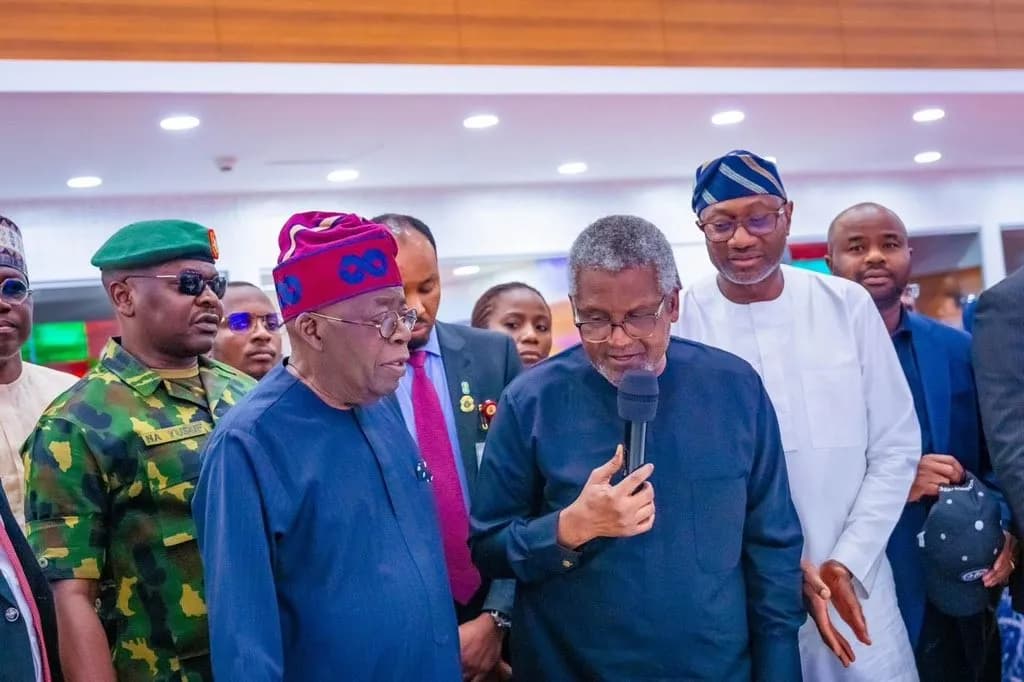
President Bola Ahmed Tinubu’s visit to Lagos’s Dangote Refinery and Petrochemicals Complex was more than a routine inspection. It reaffirmed his administration’s commitment to industrial growth, infrastructure development, and economic reform.
Here are eight major highlights from the visit:
1. Tinubu Credited as the Visionary Behind the Project
Aliko Dangote, Chairman of the Dangote Group, credited President Tinubu as the driving force behind the refinery’s location. He traced the roots of the project to Tinubu’s tenure as Governor of Lagos State, when the Lekki Free Trade Zone was established.
“The Dangote Refinery and Petrochemicals Complex is in many ways your brainchild,” Dangote said. “The Lekki Free Trade Zone was established during your tenure, and today you are witnessing the fruits of that vision.”
2. Road Leading to Refinery Named After President Tinubu
Aliko Dangote officially named the main access road to the Dangote Refinery “Bola Ahmed Tinubu Road”. This honor recognizes President Tinubu’s pivotal role in the refinery’s development. Dangote described the refinery as “in many ways your brainchild,” emphasizing Tinubu’s long-standing support and vision from the project’s earliest stages.
3. Tinubu Hails Refinery as a “Massive Investment and Point of Reference”
President Bola Tinubu praised the Dangote Refinery as a “massive investment and a point of reference” for Africa’s industrial development. He commended Aliko Dangote and his team for their visionary work and reaffirmed the government’s support for private sector-led growth.
Tinubu emphasized that the refinery is a transformative project vital for Nigeria’s ambition to become a leading global energy player while boosting local capacity building.
4. Focus on Quality Infrastructure Delivery
During the visit, Tinubu commissioned the access road to the Lekki Deep Sea Port, calling it a model of infrastructure delivery. He praised Dangote Industries Limited and Hitech Construction Company for the work done under the Tax Credit Scheme.
“I commend the quality of the access road,” Tinubu stated. “Users save vast amounts of money using this port because there’s no longer a need for trans-shipment.”
He urged governors to coordinate more closely with federal agencies on planning approvals. According to him, this will reduce compensation costs and delays on critical infrastructure projects.
5. Naira-for-Crude Policy Credited for Fuel Price Stability
Dangote applauded the Naira-for-Crude Policy introduced by Tinubu’s administration. He said the policy had helped stabilise fuel prices and improve product availability.
“This bold policy has enabled us to reduce product prices consistently,” Dangote noted. “It also stabilised our currency and supported local refineries.”
He added that products like petrol, diesel, jet fuel, and LPG have seen their lowest prices due to the policy. The approach, he said, is a step toward economic recovery and self-sufficiency.
6. Petrol Prices Now 45% Cheaper, Says Dangote
Aliko Dangote announced that petrol refined locally at the Dangote Refinery is now about 45% cheaper than previous market prices. This drop is due to eliminating import costs, shipping fees, and foreign exchange burdens that have long inflated pump prices.
Dangote emphasized, “Some people here in Nigeria might think that petrol at less than 900 naira is expensive, but there is nowhere in West Africa where petrol is not selling above $1, which is N1,600.”
This marks a major shift in Nigeria’s downstream oil sector. With full production ramping up, the refinery aims to meet all domestic fuel demand and reduce the need for subsidies, paving the way for energy self-sufficiency and price stability.
7. Major Road Projects Commissioned and Flagged Off
President Tinubu used the visit to highlight progress on national road infrastructure. He commissioned or flagged off projects such as:
- Sections of the Sokoto–Badagry Superhighway
- A 55km stretch of the Lagos-Calabar Coastal Highway
- Parts of the Maiduguri Ring Road, Zaria-Hunkuyi Road, and several key bridges
He clarified that these “legacy projects” are being awarded in segments, not as one massive contract.
“Our approach is systematic and section-based,” he said. “We are reviving corridors that connect farmlands, dams, and trade routes across Nigeria.”
8. Strong Support from Governors and Private Sector Leaders
The event drew leaders from both government and business. Tinubu praised the “four wise men” of Nigeria’s private sector — Aliko Dangote, Jim Ovia, Femi Otedola, and Abdulsamad Rabiu — for their role in the economy.
Governors from Kaduna, Ogun, Enugu, Plateau, Borno, and Abia states attended. Kaduna State Governor Uba Sani, speaking on their behalf, thanked Tinubu for removing petrol subsidies. He said the move had increased revenue for states and improved funding for social services.
“Please, my dear governors, let’s work together,” Tinubu urged. “Don’t give planning approvals without coordination.”
A Step Toward Self-Reliance
President Tinubu’s visit to the Dangote Refinery was both symbolic and strategic. It spotlighted his early role in shaping the project, while also signaling his administration’s focus on building infrastructure and supporting local production. With national road projects underway and fuel prices easing, the visit marked a major milestone in Nigeria’s push toward economic self-reliance.