

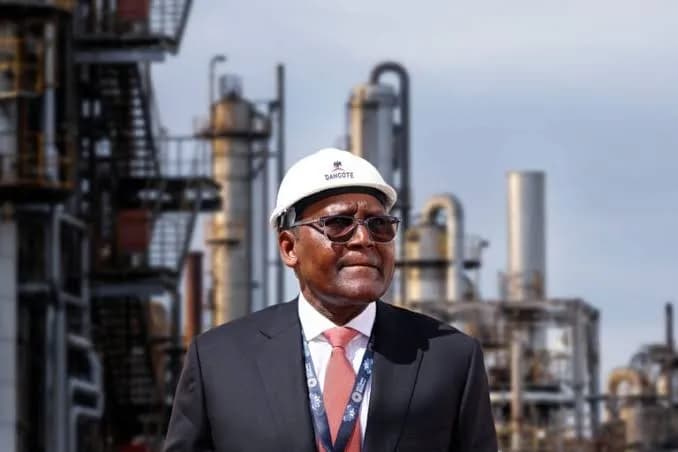
President of the Dangote Group, Alhaji Aliko Dangote, has warned that entrenched rent-seeking and foreign control over Africa’s petroleum trade could block future refinery projects. He urged governments to take bold, coordinated political action to reverse the trend.
Speaking Tuesday at the Global Commodity Insights Conference on West Africa’s Refined Fuel Market in Abuja, Dangote described the sector as plagued by corruption, sabotage, and manipulation. The Nigerian Midstream and Downstream Petroleum Regulatory Authority (NMDPRA) and S&P Global Commodity Insights hosted the event.
During his presentation titled “Building an African Refinery Hub: Prospects and Challenges,” Dangote said that infrastructure and financing challenges are secondary. According to him, the true barrier to investment lies in the systemic rent-seeking across the petroleum value chain.
Floating Storage Hub ‘Designed to Kill Refinery Investment’
Dangote identified the Lomé Floating Storage Terminal as a key structural challenge. Located offshore near Togo, the terminal reportedly holds over two million tonnes of petroleum products and serves much of West and Central Africa.
“This is a uniquely African phenomenon,” he said. “International traders operate floating fleets just offshore. They sell at inflated prices because our region lacks enough refining capacity.”
He argued that these foreign players use the terminal to prevent competition. “The Lomé floating market exists to block refineries in sub-Saharan Africa,” he said. “Without dismantling that setup, no major project will succeed in such a distorted environment.”
‘We Will Not See Another Major Refinery in Our Lifetime’
Dangote warned that unless African leaders act, no new refinery will be built in the foreseeable future.
“Let me be blunt,” he said. “If strong political will doesn’t emerge, no one in this room—including me—will live to see another major refinery in sub-Saharan Africa.”
He added that new refineries challenge deeply rooted interests. “You’re not just entering the market,” he said. “You’re threatening powerful networks that profit from our dependence on imports.”
Dangote Refinery Faced Coordinated Pushback
Speaking about the $20 billion Dangote Refinery in Lekki, Lagos, which began operations in 2023, Africa’s richest man said it faced intense local and international resistance.
“Many actors benefited from scarcity, inefficiencies, and inflated prices,” he said. “Once our refinery started operations and prices fell, some of them became uncomfortable.”
Though his refinery overcame these obstacles, Dangote expressed concern for future investors. “What we’ve done shouldn’t be the exception,” he said. “But without reform, it probably will be.”
Regional Cooperation and Bold Reform
Dangote called on African governments to align their policies, regulate offshore hubs more strictly, and create investment incentives for domestic refining.
“If we fail to act now,” he said, “we’ll stay dependent on foreign-controlled supply chains that profit from our weakness. Africa must focus on energy sovereignty and true economic independence.”
The 650,000 bpd Dangote Refinery, now the world’s largest single-train facility, has begun reshaping fuel supply across West Africa. But its long-term impact, Dangote insists, hinges on whether African leaders confront the deeper issues that keep the continent reliant on imported fuel.