

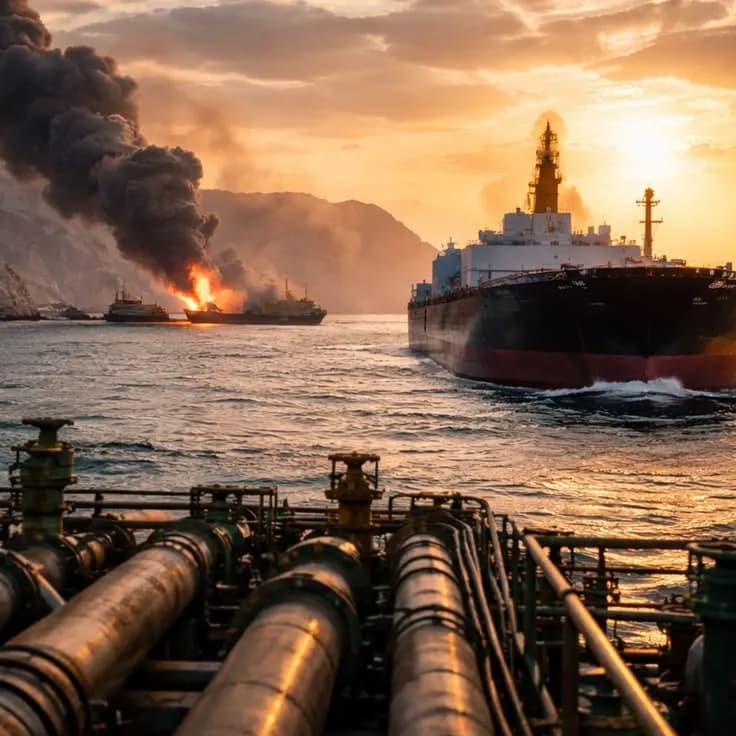
Iran has re-imposed its closure of the Strait of Hormuz barely hours after declaring it open, leaving several commercial vessels stranded mid-passage on Saturday as the standoff between Tehran and Washington showed no signs of resolution.
The strait, which before the current crisis served as the transit corridor for roughly 20 per cent of the world's liquefied natural gas and 25 per cent of global seaborne oil trade, has been largely closed since 28 February 2026. Tanker traffic through the waterway has since fallen by more than 90 per cent, with war risk insurance premiums rising four to six times above pre-conflict levels, developments that have contributed to sustained upward pressure on global crude prices with direct consequences for oil-dependent economies across Africa.
Iranian state television, citing a statement from the country's military central command, announced that the strait was back "under strict management and control of the armed forces." Tehran blamed the reversal on the United States' continued naval blockade of Iranian ports, which President Donald Trump has refused to lift pending a final peace agreement.
The reversal came a day after Iran's Foreign Minister Abbas Araghchi declared the waterway fully open to commercial shipping, in line with a ceasefire agreed to halt Israel's war with Hezbollah in Lebanon. The announcement had briefly lifted market sentiment and sent oil prices sharply lower.
Maritime tracking data showed a number of vessels had already entered the strait when the re-closure was declared on Saturday morning. At least two tankers headed eastward from UAE ports towards India appeared to abort their journeys, turning back amid the uncertainty. Several other ships were observed hugging Iranian territorial waters and broadcasting their nationality, with some identifying themselves as Indian or Chinese in an apparent attempt to signal neutrality and secure safe passage.
Speaking at an event in Phoenix, Arizona, on Friday, Trump reiterated that the US naval blockade of Iranian ports would remain in full force until a formal deal was signed. At the same event, Trump claimed Iran had agreed to surrender approximately 440 kilogrammes of uranium enriched to 60 per cent, close to weapons grade. Iran's foreign ministry rejected the claim within hours, with spokesman Esmaeil Baqaei telling state television that the stockpile "is not going to be transferred anywhere."
Peace negotiations held in Islamabad between US Vice President JD Vance and Iranian officials last weekend ended without agreement. A second round of talks is reported to be under consideration for this weekend, though the uranium stockpile dispute and the future status of the strait itself remain the two principal sticking points.
The crisis traces back to 28 February 2026, when the United States and Israel launched coordinated strikes on Iran under Operation Epic Fury, resulting in the death of Supreme Leader Ali Khamenei Iran's Islamic Revolutionary Guard Corps has since carried out over 20 confirmed attacks on merchant vessels in and around the strait and has reportedly laid sea mines in the waterway.