

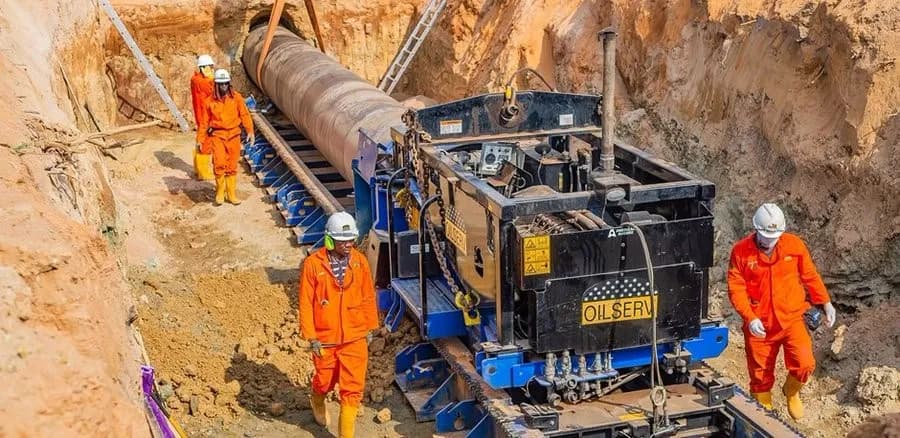
The Nigerian National Petroleum Company Limited (NNPC) says mechanical work on the $2.8 billion Ajaokuta-Kaduna-Kano (AKK) gas pipeline will finish by November 2025. After three postponements, the 614-kilometre project is now 86.05% complete and expected to deliver 2.2 billion standard cubic feet of gas daily to power plants in Abuja, Kaduna, and Kano.
Mechanical completion means welding, installation, and fittings will be ready for pre-commissioning tests. NNPC had previously aimed for a December 2023 finish. That deadline shifted first to late 2024 and then to the first quarter of 2025.
At the 2025 AKK Pipeline Progress Update in Abuja, NNPC’s Group Chief Executive Officer, Bayo Ojulari, called the project a defining moment for Nigeria’s energy security and industrial future.
“This is not just another pipeline,” Ojulari said. “It will power homes, revive factories, and unlock new economic opportunities.”
Boosting Industry and Energy Security
Ojulari noted that the AKK pipeline will help Nigeria’s North rebuild its manufacturing base. Once operational, it will support power plants generating 1,350 megawatts in Abuja and Kaduna, and 900 megawatts in Kano.
Construction has created over 1,900 direct jobs so far. Officials also expect thousands of new roles to emerge across logistics, trade, and industrial services.
NNPC plans to develop industrial parks in Ajaokuta and Kano, located along the pipeline route. These hubs aim to attract private capital, stimulate tax revenue, and empower local businesses.
The AKK project aligns with Nigeria’s Decade of Gas strategy, which seeks to reduce reliance on oil and expand the use of cleaner fuels. Ojulari added that compressed natural gas (CNG) delivered through the pipeline will cut transport costs and help lower emissions.
He also said the pipeline would support agriculture, boost rural economies, and enhance food distribution nationwide. In the long term, it could extend to North Africa and strengthen regional trade links.
Final Phase and Strategic Financing
Audu Ibrahim, Executive Director at Nigerian Gas Infrastructure Company (NGIC), confirmed the River Niger crossing is complete. The welded section from KP303 to Kano is now ready to receive gas.
He assured that all physical works would conclude by late 2025. Control and monitoring systems will follow in 2026. While terrain, insecurity, and funding delays slowed progress, NNPC says those problems are now resolved.
Under the Petroleum Industry Act (PIA), NNPC no longer depends on federal allocations. Instead, it raises funds from capital markets. Olalekan Ogunleye, Executive Vice President for Gas, Power, and New Energy, explained that NNPC now operates like a commercial entity with bankable projects.
“Funding is no longer an excuse,” Ogunleye said. “We engage investors as a credible energy company.”
As completion draws near, the AKK pipeline stands ready to reshape Nigeria’s energy economy, expanding access, powering growth, and linking regions in new ways.