

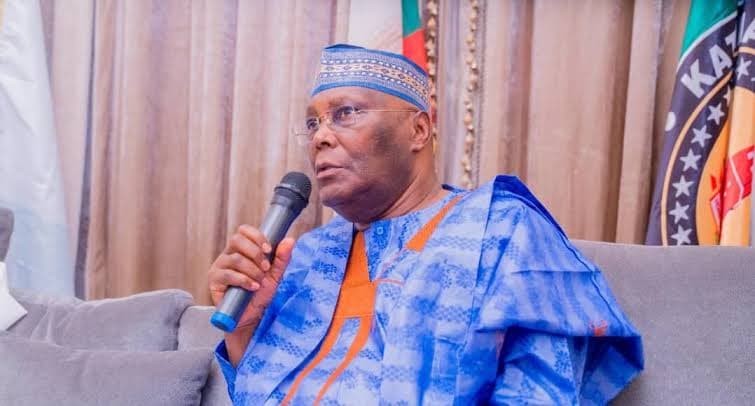
Former Vice President Atiku Abubakar has proposed replacing Nigeria’s former petrol import subsidy with a targeted production-support programme for local refineries if he wins the 2027 presidential election.
The proposal, contained in the Atiku Economic Recovery Plan (AERP) 2027 and disclosed by his Senior Special Assistant on Public Communication, Phrank Shaibu, would make qualifying public and private refineries eligible for preferential domestic crude supplies in exchange for verifiable production and domestic petroleum deliveries.
Atiku said the plan was designed to reduce energy costs while expanding domestic refining, arguing that the debate should not be limited to whether Nigeria should have a subsidy, but whether any intervention is transparent, measurable and capable of delivering value to consumers.
“My proposal is not to resurrect the old subsidy regime. We will move subsidy from importation to production, from middlemen to Nigerian refineries, and from unverifiable claims to verifiable barrels,” he said.
Under the proposed framework, participating refineries would receive crude at a preferential price, subject to conditions covering production, efficiency, transparency and domestic supply.
Atiku acknowledged that selling crude below its market-equivalent value would impose an opportunity cost on the Federation. He said that cost would be explicitly calculated and disclosed under his proposed system.
“The cost will be known. The ceiling will be known. The beneficiaries will be known. And, most importantly, the benefit delivered to Nigerians will be measurable,” he said.
He added that the government would establish its fiscal capacity before determining the level of support, rather than committing to subsidies without knowing their eventual cost.
The proposal would also require refineries benefiting from preferential crude to demonstrate that the resulting advantage reaches consumers.
According to Atiku, subsidised crude would only be allocated where independently verified volumes of refined products are supplied to the Nigerian market under a transparent pricing formula that reflects the value of the crude concession.
The framework would track crude allocations, refinery intake, production yields, inventories and domestic deliveries to establish a traceable link between government support and petroleum products supplied to consumers.
Atiku said operators would not be permitted to benefit from preferential crude while diverting the resulting products to more lucrative foreign markets.
Refineries that divert subsidised crude or products, falsify production records, breach domestic-supply requirements or fail to transfer the prescribed benefit to consumers would lose eligibility, repay the subsidy benefit and face regulatory or legal sanctions, according to the proposal.
He said participation would be based on objective criteria rather than political connections, with eligibility determined by independently verified refinery capacity, operational efficiency, domestic supply and compliance.
The proposed intervention would also have a built-in expiry mechanism. Atiku said the support would be reduced progressively as domestic refining capacity expands, refinery utilisation improves, competition increases and production costs fall.
“Our objective is not permanent subsidy. It is to use temporary and disciplined support to build a refining industry strong enough eventually not to need subsidy,” he said.
The former vice president said the programme would be periodically assessed against its fiscal cost and indicators including refinery output, domestic petroleum prices, employment, investment and benefits delivered to consumers. He said the intervention should be modified or discontinued if it failed to produce sufficient value.
Atiku argued that lower refining costs would ultimately reduce the prices of petrol and diesel and ease pressure on other parts of the economy.
He also criticised the Federal Government’s handling of the subsidy removal announced by President Bola Tinubu on May 29, 2023, saying Nigerians immediately absorbed the resulting increase in petrol and transportation costs.
According to Atiku, the policy contributed to higher transport and food costs, while questions remain over petroleum-related expenditures recorded in government accounts after the subsidy was officially removed.
He cited NNPCL audited financial statements showing Energy Security Expenses of approximately ₦4.84 trillion in 2023 and ₦7.13 trillion in 2024.
Atiku said the figures require a clearer explanation of their economic composition, including whether they contained under-recoveries, pricing differentials or other costs connected with petroleum supply.
“We are not interested in playing games with accounting terminology,” he said.
He argued that if government continued to absorb differences between the economic cost of petroleum products and the amount recovered from consumers, such expenditures should be explained against the government’s declaration that the subsidy had been eliminated.
“If government continued absorbing differences between the economic cost of petroleum products and what was recovered from the market, then Nigerians are entitled to ask how that differs economically from the subsidy they were told had disappeared,” Atiku said.
“You cannot abolish subsidy at Eagle Square and allow subsidy-like costs to resurface in government accounts without explaining the contradiction.”
The proposal forms part of Atiku’s broader economic platform ahead of the 2027 presidential election, in which he is seeking to challenge Tinubu and other presidential contenders.