

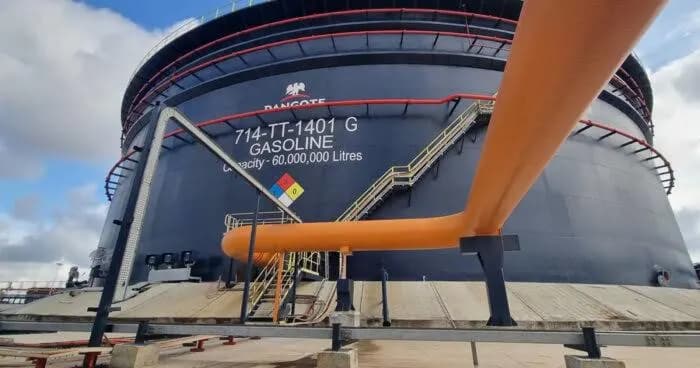
Dangote Petroleum Refinery has reduced its diesel (Automotive Gas Oil) gantry price by ₦100, bringing it to ₦1,500 per litre, in its latest adjustment amid sustained downward pressure in Nigeria’s downstream market. The cut represents a 6.25 percent reduction from the previous ₦1,600 per litre level, marking the second diesel price review by the refinery this week, following an earlier adjustment on Tuesday, June 16.
The move follows continued price weakness across Lagos depots, where aggressive selling has pushed diesel offers lower as marketers rush to clear stock in anticipation of further declines. Recent trading sessions have seen multiple depots hover around the ₦1,565–₦1,570 per litre range, with occasional lower deals depending on liquidity pressure and inventory positions.
The persistent slide has been driven largely by intensified competition and what market participants describe as panic selling, as traders prioritize quick turnover over margin protection in a fast-moving market.
The latest adjustment by Dangote Petroleum Refinery comes as refinery pricing continues to track the widening gap between its gantry rate and lower depot offers. A source at the refinery noted that if private depots consistently sustain prices below its benchmark, Dangote Petroleum Refinery will be forced to review its prices lower to stay competitive in the deregulated market.
Global crude oil trends have also added to the pressure. As at 10:00 WAT, Brent crude traded at $79.53 per barrel, down 0.40%, while West Texas Intermediate (WTI) stood at $75.83 per barrel, easing 0.03%, reflecting a generally softer international pricing environment.
Market operators expect further price alignment in the near term if current depot-level competition persists, as downstream pricing continues to adjust rapidly to shifting demand and supply dynamics.