

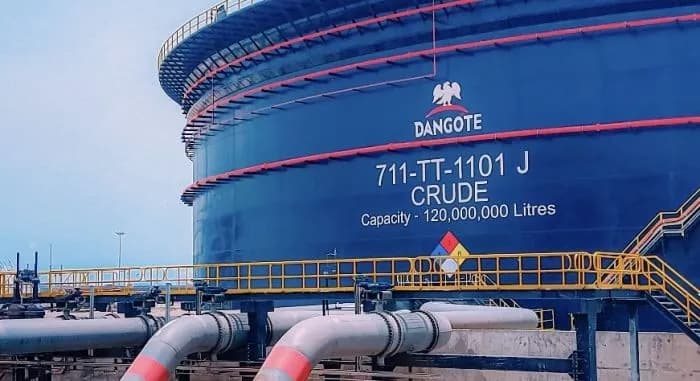
Dangote Petroleum Refinery has begun importing gasoline components for blending to support petrol (PMS) supply while maintenance work continues at its Lekki facility, according to shipping and trade-flow data reviewed by Petroleumprice.ng.
The imports signal tighter product availability at the refinery, even as it sustains large-scale truck loading for the domestic market. Industry sources say Dangote is using the imported gasoline components solely for PMS blending to bridge short-term supply gaps, not as a substitute for core refining operations.
Gasoline Components Arrive for PMS Blending
Shipping records show that at least two Medium Range (MR) product tankers carrying gasoline components are scheduled to discharge at Dangote Refinery in late January.
One vessel, Ion M, loaded gasoline components at Immingham, United Kingdom, a major Northwest European export hub. The tanker is carrying about 38,000 metric tonnes of gasoline blendstock under charter to Dangote Refinery and is due to arrive at the Lekki terminal on 21 January.
Another tanker, Silver Ginny, lifted a similar 38,000-metric-tonne gasoline component cargo from Lavera, France, one of the Mediterranean’s largest refining and export centres. Shipping estimates place its arrival around 25 January.
Both cargoes consist of unfinished gasoline components, not finished petrol. The refinery will blend them with existing refinery streams to meet PMS specifications for the Nigerian market.
Additional Gasoline Components for Blending
Trade data also show the arrival of condensate and naphtha cargoes, which support feedstock availability and gasoline blending operations.
The vessel St Nenne, operated by Vitol, discharged condensate and naphtha at Dangote Refinery between 16 and 17 January, according to shipping data. The tanker anchored on 14 January after loading ex-Ningbo under a Bonny-linked trade route and was listed as the next vessel scheduled for discharge at the refinery.
The cargo comprised an estimated 30,000 metric tonnes of condensate and 6,000 metric tonnes of naphtha, volumes consistent with feedstock support and gasoline component optimisation for PMS blending.
Market sources say these arrivals reinforce the view that the refinery is supplementing output with imported streams to keep petrol supply steady during maintenance-related constraints.
What Gasoline Components Are Used For
Gasoline components are unfinished or semi-finished petroleum products that require blending with other refinery streams before they meet PMS specifications. Retailers cannot sell them directly as finished petrol.
Common gasoline components include:
- Naphtha
- Reformate
- Alkylate
- Isomerate
- Straight-run gasoline
- FCC (cracked) gasoline
Each component performs a specific function in blending. Some raise octane levels, others control vapour pressure, meet sulphur limits, or increase blending volume. Refiners import these components to manage unit outages, crude slate limitations, or short-term supply disruptions.
Maintenance Pressures and PMS Supply Strain
Earlier reporting by Petroleumprice.ng showed that Dangote Refinery is carrying out maintenance on key processing units, which has constrained overall throughput.
Despite these limitations, the refinery continues to load about 50 million litres of PMS daily, supported by roughly 1,000 truck movements. Market analysts say this sustained offtake has tightened petrol stocks, making the use of imported gasoline components for blending a necessary short-term measure.
“Gasoline component blending is a balancing tool,” a downstream analyst said. “It helps cover supply gaps when refining units are constrained. It does not replace full-scale refining.”
Market Implications
The arrival of gasoline components from the UK and Mediterranean export hubs highlights Nigeria’s growing reliance on European blending supply chains during periods of domestic operational pressure.
For the domestic market, the imports indicate that PMS supply remains delicate despite ongoing refinery operations. Until maintenance work concludes and full refining capacity normalises, short-term supply stability is likely to continue relying on imported gasoline components for PMS blending — not finished petrol imports and not blending-led refining.