

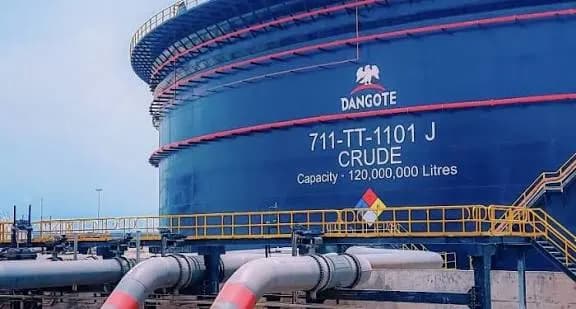
The Dangote Refinery has suspended sales of Automotive Gas Oil (AGO), popularly known as diesel, at a time when global crude oil prices are climbing. The refinery’s last Pro Forma Invoice (PFI) price stood at ₦880 per litre. Now, with sales halted, industry operators are reading the move as a clear sign of an impending upward price review.
In the downstream sector, when a dominant supplier pauses loading, the market listens.
Lagos Depots Move to ₦1,100 as Market Prices in Risk
Even before Dangote Refinery sets a new ex-depot price, Lagos depots have moved ahead.
As of March 2, major depots are loading diesel uniformly at ₦1,100 per litre.
- Integrated: ₦1,100
- African Terminal: ₦1,100
- Ibachem: ₦1,100
- Duport: ₦1,100
- Emadeb: ₦1,100
- First Royal: ₦1,100
- Swift: ₦1,100
- Ibeto: ₦1,100
- Wossbab: ₦1,100
This kind of price uniformity reflects one thing replacement cost anxiety.
Depot owners and marketers understand the pricing cycle. When crude strengthens and a major refinery suspends PFI issuance, the smart move is to adjust early. No operator wants to sell today at a loss tomorrow.
Simply put, the market has already factored in a higher landing cost and tighter supply window.
Brent at $79.73: Feedstock Economics Tighten
At press time 6: 50AM ( WAT), Brent Crude traded at $79.73 per barrel, up 2.56 per cent.
That movement is critical.
Brent is Nigeria’s pricing benchmark. When it rises, crude feedstock becomes more expensive. Even though diesel is refined locally, the input crude is dollar-based. Add foreign exchange exposure, operational costs, financing charges and logistics, and the cost build-up becomes obvious.
Refinery economics do not operate in isolation. Margins must reflect crude cost, refining spread and market realities. Sustaining a sub-₦1,000 ex-depot price becomes increasingly difficult under these conditions.
₦1,000 Per Litre: The New Benchmark?
The debate is no longer whether diesel prices will rise, but by how much.
Market players expect the Dangote Refinery’s ex-depot price to exceed ₦1,000 per litre. With Lagos depots already loading at ₦1,100, selling below that would disrupt the market and squeeze margins.
Crossing ₦1,000 resets the downstream chain: haulage rates rise, manufacturers revise costs, telecoms adjust diesel budgets, and small businesses feel the impact immediately.
Diesel powers Nigeria’s industrial and logistics sectors, so any ex-depot increase inevitably filters to pump prices and consumer goods.
The current sales suspension signals a major adjustment ahead. In a deregulated market, supply pauses often precede new price benchmarks and the diesel market is bracing for a significant reset.