

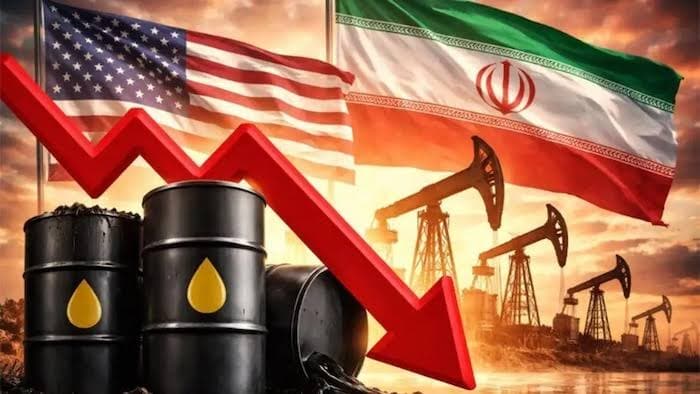
Crude oil prices extended their decline early Thursday, with Brent crude falling below the $100 per barrel mark as advancing diplomatic efforts between the United States and Iran reduced some of the geopolitical risk premium attached to Middle East supply.
As at the time of writing 04:18am (WAT), Brent crude was trading at $97.42 per barrel, down 0.62%, while US West Texas Intermediate (WTI) stood at $89.66 per barrel, down 0.84%.
The latest weakness follows renewed diplomatic activity between Washington and Tehran, with Iran confirming that it had received a US response to its latest proposal aimed at reviving a collapsed ceasefire and easing the conflict. Qatar has continued to act as a mediator between the two sides.
Iran's proposal includes a seven-day framework under which the United States would ease its blockade of Iranian ports while Tehran would reopen the Strait of Hormuz and restore normal maritime passage. However, the two sides remain divided over the sequence for implementing the proposed measures, meaning there is still no confirmed agreement to fully reopen the strategic waterway.
For the oil market, the significance of the discussions lies in their potential effect on physical supply. The Strait of Hormuz remains a critical transit route for crude, refined products and natural gas, and disruption to shipping through the waterway has kept supply concerns elevated. Although vessel movements have increased, security risks continue to affect shipping costs and the willingness of operators to use the route.
The price decline therefore reflects a shift in market expectations rather than a sudden deterioration in global oil demand. Traders are reassessing the likelihood and duration of supply disruptions as diplomatic channels remain active, while recovering Middle East export flows have also provided some relief to the physical market. Reuters reported that Middle East crude exports increased in September, although flows remain affected by the conflict.
The market remains highly sensitive to developments around Hormuz. Any credible progress towards reopening the waterway and restoring normal shipping could reduce freight, insurance and supply-risk premiums. Conversely, renewed attacks on shipping or energy infrastructure could quickly reverse the recent decline and place fresh upward pressure on crude prices.
For Nigeria's downstream market, the movement is particularly relevant because international crude benchmarks feed into the economics of imported petroleum products. A sustained reduction in geopolitical risk could moderate crude-related pressure on import-parity costs, although freight, insurance, exchange rates and other landing-cost components would continue to determine the final cost of imported products.
Meanwhile, analysts surveyed by Reuters have raised their 2026 oil-price forecasts as prolonged disruption to Gulf exports continues to outweigh concerns about weaker demand growth. The latest outlook underscores the fact that, despite the retreat below $100, the market has not returned to normal supply conditions.
Brent's move below $100 marks another adjustment in the market's geopolitical risk premium, but the direction of prices will depend heavily on whether the US-Iran diplomatic process produces a workable arrangement for restoring shipping through the Strait of Hormuz. Until physical flows normalise more fully, crude prices are likely to remain sensitive to developments affecting Gulf exports and maritime security.