

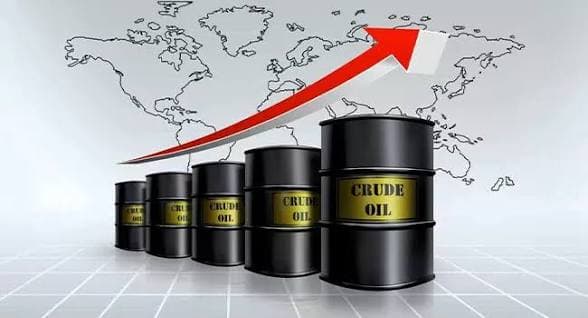
Brent crude prices jumped by more than 3 per cent on Friday evening as renewed tensions around the Strait of Hormuz and concerns over Russian oil supplies heightened fears of further disruptions to global crude flows.
As at the time of writing 7:30 p.m. (WAT), Brent crude was trading at $109.70 per barrel, up 3.58 per cent, while West Texas Intermediate (WTI) rose by 3.51 per cent to $101.40 per barrel, according to market data available at the time of writing.
The rally reflects growing concerns over the security of oil shipments through the Strait of Hormuz, a critical route for crude exports from major Middle Eastern producers. Renewed attacks on vessels in the region have heightened the risk of further supply disruptions, keeping geopolitical uncertainty at the centre of international oil pricing.
Concerns over Russian oil supplies have also supported prices following Ukrainian attacks on Russian oil infrastructure. Potential disruptions to refinery operations and petroleum product exports have added to market uncertainty, as traders assess the combined impact of developments in the Middle East and Russia on global energy supplies.
US inventory data provided additional support, particularly for WTI. US crude inventories fell by 8.56 million barrels in the week to October 9, according to data cited by Reuters, exceeding market expectations and reinforcing concerns about near-term crude availability.
The price gains came despite efforts to ease supply pressures through emergency oil stock releases and measures aimed at improving tanker availability. However, these interventions have yet to eliminate concerns over the potential impact of prolonged disruptions to shipping routes and petroleum infrastructure.
For Nigeria, sustained crude prices above $100 per barrel could support export earnings and government revenue, depending on production volumes, export performance and fiscal arrangements. However, higher international oil prices could also increase the cost of imported petroleum products and put upward pressure on domestic fuel prices, particularly if freight, insurance and foreign-exchange costs rise.
With Brent trading close to $110 per barrel, the market direction will depend largely on developments around the Strait of Hormuz, the impact of attacks on Russian oil infrastructure and the outlook for global inventories. Any further disruption to physical supply could sustain the rally, while diplomatic progress and improved shipping conditions could ease the geopolitical risk premium.