

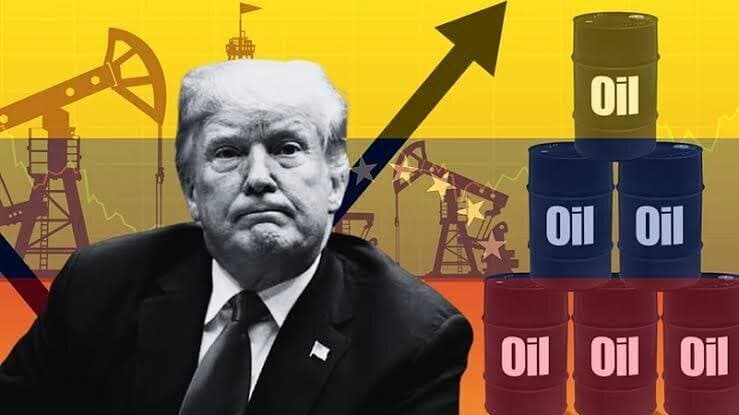
Brent crude climbed towards $120 per barrel as escalating tensions between Saudi Arabia and Yemen’s Houthi movement fuelled another weekly rally, intensifying pressure on U.S. President Donald Trump amid growing disruptions across global energy markets.
The international benchmark traded around $117 per barrel on Friday, October 23, putting it on course for a weekly gain of approximately 4%, as geopolitical risks added to concerns over oil supply security and the rising cost of delivering crude to international buyers.
The latest rally comes despite some easing in tanker freight rates and a flattening of backwardation across oil futures curves, which reduced price premiums for several crude grades and partly offset pressure from higher benchmark prices.
However, renewed attacks across the Middle East have heightened concerns over energy infrastructure and shipping routes, leaving the oil market vulnerable to further supply disruptions.
Saudi Aramco, the kingdom’s state-owned oil company, ordered staff to evacuate its headquarters in Dhahran and temporarily work remotely after a Houthi attack, according to reports cited by the source. Drone strikes also reportedly killed two people at the Shaybah oilfield.
The evacuation marked the first such move involving the company’s headquarters since the Iran war began, adding to concerns about the security of Saudi Arabia’s energy infrastructure.
The combination of rising crude prices, threats to production facilities and increasingly expensive global energy logistics presents a difficult challenge for Trump, whose administration faces pressure to contain fuel costs while managing a deteriorating geopolitical environment.
The strain is also spreading beyond crude oil. The U.S. Department of Energy is offering 315,000 barrels of diesel from the Northeast Home Heating Oil Reserve to address regional supply disruptions as global diesel exports decline.
The volume represents approximately one-third of the reserve. The department has presented the measure as temporary relief, with the first Russian diesel cargoes under a separate arrangement with Washington expected to arrive in early November.
A non-sanctioned, Malta-flagged tanker, the Agioi Fanendes, has departed Russia’s Baltic Sea port of Primorsk with New York listed as its destination. The cargo is expected to arrive on November 7, marking the first diesel shipment under the reported agreement between Washington and Moscow.
The developments underscore the growing difficulty of maintaining stable fuel supplies as geopolitical tensions and transportation costs disrupt traditional trading routes.
Europe is also facing mounting energy pressures ahead of winter. The Dutch TTF natural gas benchmark rose above €93 per megawatt-hour, equivalent to approximately $30 per million British thermal units, its highest level since December 2022.
The increase reflects restricted Qatari liquefied natural gas (LNG) supplies, colder weather and European gas storage levels that peaked below 75%, leaving the region exposed to further supply constraints as winter approaches.
QatarEnergy is seeking additional long-term LNG cargoes from the United States and potentially Asia as it works to rebuild its supply base. The company has secured an agreement with U.S. LNG developer Cheniere for four million tonnes of LNG annually through 2054, although its existing LNG outflows remain constrained.
The disruption to energy flows is also affecting crude production in North Africa. Libya’s National Oil Corporation reported that unauthorised individuals shut a pipeline valve serving the Hamada and Tahara oilfields, cutting production by 50,000 barrels per day and 40,000 barrels per day, respectively.
The recurring protests and disruptions threaten a sector responsible for approximately 90% of Libya’s state revenues, adding another source of uncertainty to global oil supply.
Meanwhile, an oil spill from the Gem No. 2, a very large crude carrier reportedly struck by missiles two weeks earlier, has affected coastal areas around Umm Al Quwain in the United Arab Emirates. Authorities closed affected beaches and began containment operations as currents carried contamination towards desalination facilities.
The latest developments highlight the vulnerability of energy infrastructure and maritime transport to regional conflict, even as governments and producers attempt to secure alternative supplies.
Beyond the Middle East, governments are taking steps to strengthen domestic energy production and reduce exposure to international supply shocks.
China has instructed state-owned oil companies PetroChina, Sinopec and CNOOC to accelerate oil and gas exploration and production and build strategic supply bases. The move is intended to strengthen the country’s resilience against supply disruptions, with Chinese oil production currently averaging 4.43 million barrels per day.
Mexico’s state oil company Pemex has also pledged to direct $99 billion towards upstream activities between 2025 and 2030, representing 80% of its investment budget. The programme aims to counter declining production, with Mexican crude output averaging approximately 1.34 million barrels per day so far in 2026.
Indonesia, meanwhile, is considering ending pipeline gas exports to neighbouring countries to prioritise domestic demand. Such a move could remove approximately seven billion cubic metres of annual supply from Singapore, equivalent to around 45% of the city-state’s consumption.
The United States is also reviewing its energy policies. Trump has declared imported wind turbines and related components a national security threat, citing cybersecurity risks and dependence on foreign suppliers. He has directed trade officials to discuss the issue with trading partners following a Commerce Department investigation.
Japan is considering gradually reducing its gasoline subsidy programme from December as the scheme consumes billions of dollars monthly and draws down a $20 billion budget. Average gasoline prices could rise from approximately $4.10 per gallon currently to $4.35 per gallon in January if the proposed changes proceed.
The oil rally is also reshaping crude trading between the Americas, Europe and Asia. Higher freight costs have made some shipments from the U.S. Gulf Coast to Asian refiners less competitive, encouraging buyers to consider alternative suppliers in the Middle East and Latin America.
In some cases, heavy crude has accumulated in the Americas because transporting it overseas has become too expensive, even as refiners in other regions struggle to secure suitable supplies. The mismatch illustrates how logistical constraints can create regional shortages despite the availability of crude elsewhere.
Meanwhile, the European Union is preparing its 22nd sanctions package against Russia. The proposed measures would target 12 individuals and 105 entities linked to Russian oil production, trading, refining, shipping and logistics, extending pressure on Moscow even as Washington and Russia discuss broader economic issues.
Not all energy prices are following the same direction. U.S. natural gas futures fell to a two-month low of $2.66 per million British thermal units as mild weather, recovering offshore supplies and above-average inventories outweighed record LNG demand. Calendar-year 2027 futures also declined to a five-year low of $3.09 per million British thermal units.
The divergent movements show how regional supply conditions, weather and infrastructure constraints can drive different outcomes across energy markets, even when crude oil prices are rising sharply.
For Trump, the challenge is balancing the need to contain domestic fuel costs against mounting geopolitical risks, disrupted trade routes and the expense of securing alternative energy supplies.
With Brent approaching $120 per barrel, renewed attacks on energy infrastructure, falling Libyan production and constrained gas supplies in Europe, the pressure on governments and consumers is extending well beyond the crude market.
The direction of oil prices will depend heavily on whether tensions in the Middle East escalate further, how quickly disrupted supplies can be restored, and whether global shipping capacity can recover sufficiently to ease the cost of moving energy between producing and consuming regions.