

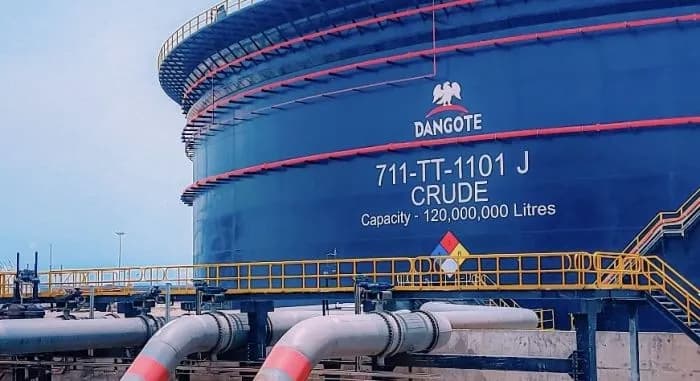
When the Dangote Petroleum Refinery was commissioned in May 2023, it was heralded as a game-changer a bold move toward breaking Nigeria’s decades-long addiction to imported refined fuel. With an installed capacity of 650,000 barrels per day (bpd), the Lagos-based facility is Africa’s largest, built to refine multiple grades of crude into petrol (PMS), diesel (AGO), aviation fuel, and other products.
Two years later, the question persists in policy and industry circles: Can this refinery truly bring an end to petrol importation in Nigeria, or is this an ambitious vision running ahead of real-world readiness?
Downstream Disruption: From Import Dependency to Local Supply
Nigeria’s historical reliance on petrol imports despite being Africa’s top crude producer has long been blamed on its moribund state-owned refineries. However, early indicators suggest Dangote’s entry is already shifting the needle.
In Q1 2025, Nigeria’s petrol import bill dropped by ₦2.05 trillion (a 54% decline), thanks to growing output from the refinery. By June 2025, the plant was refining 550,000 bpd, sourcing 53% of its crude locally and the remaining from international markets notably WTI from the United States.
This domestic dominance has driven down PMS prices. By July 8, 2025, ex-depot petrol prices had fallen from ₦880/litre to ₦820, triggering a pricing ripple across filling stations in Lagos and Ogun, where fuel is now sold between ₦875–₦890/litre below the national average.
Yet, Dangote is not stopping there. The company plans to begin direct fuel distribution on August 15, using a fleet of 4,000 CNG-powered trucks and investing over ₦1 trillion annually in logistics. The strategy aims to cut off middlemen, a move that’s already raising concern among depot owners and marketers over market dominance and shrinking margins.
Crude Supply: The Biggest Constraint in Ending Imports
Behind the refinery’s full potential lies a massive challenge crude supply sufficiency. While Dangote Refinery is ramping up operations, the ability to eliminate petrol imports depends heavily on consistently sourcing all crude feedstock locally.
Aliko Dangote, President of the Dangote Group, made a strong commitment during a press briefing in May 2023, as reported by the media :
“We aim to transition to full domestic crude supply by Q4 2025, leveraging Nigeria’s abundant resources to eliminate reliance on imported crude.”
This pledge was reinforced in a July 2025 Bloomberg report, where a refinery spokesperson stated:
“By December 2025, our 650,000 bpd facility will process exclusively Nigerian crude, supported by the government’s Naira-for-Crude initiative.”
This plan, if fully realised, could displace hundreds of thousands of barrels of imported crude daily. However, in June 2025, the refinery still relied on imports for 47% of its feedstock, mostly from the US, Brazil, Angola, and Equatorial Guinea a reflection of Nigeria’s own supply gaps.
The federal government’s Naira-for-Crude initiative, championed by President Bola Ahmed Tinubu, aims to prioritise domestic allocation by requiring producers to sell crude to local refiners in naira. The NNPCL has committed to supplying five cargoes per month to the refinery through July and August.
But serious challenges remain. Nigeria’s crude output currently averages 1.2–1.4 million bpd, far short of its 2 million bpd potential. Persistent issues such as pipeline vandalism, oil theft, and years of underinvestment in upstream infrastructure cast doubt on the country’s ability to meet Dangote’s full feedstock demand.
Without bold upstream reforms, Dangote’s ambitious goal of refining only Nigerian crude by year-end may face delays.
Economic Impact: Forex Savings, Inflation Pressure, and Market Disruption
The refinery’s ramp-up is already transforming Nigeria’s energy trade balance. The country became a net exporter of refined products in 2025, with West African petrol imports from Europe falling by 20% year-on-year in June. Analysts estimate this could save Nigeria around $6 billion annually in foreign exchange, equivalent to 2% of GDP.
Economists such as Bismarck Rewane believe that the combination of lower pump prices and logistics savings could help ease inflation which stood at 22.97% in May 2025 and support millions of MSMEs struggling with operating costs.
However, there’s a growing concern within the downstream market. The refinery’s direct-to-market model threatens existing supply chains, leaving depot owners and independent marketers vulnerable. Groups like PETROAN and IPMAN have warned of possible job losses and anti-competitive practices.
Operational Risks: Infrastructure Gaps and Market Volatility
Dangote’s investment in CNG-powered distribution is bold, but infrastructure weaknesses across ports, roads, and regional terminals could undermine national rollout. Reaching underserved states efficiently by August will require rapid deployment and coordination.
Externally, global price shocks still pose risks. The refinery’s pricing though competitive remains exposed to Brent volatility, as witnessed during the June 2025 Israel-Iran crisis. Should global prices spike again, Dangote’s low-cost advantage could narrow.
A Powerful Start, But Not Yet the Finish Line
There is no doubt that the Dangote Refinery is disrupting Nigeria’s downstream landscape. With a 54% cut in petrol imports already on record, the facility is pushing the country closer to energy self-sufficiency.
But ending petrol imports by December 2025, while technically achievable, depends on multiple moving parts: stable local crude supply, regulatory discipline, infrastructure delivery, and competitive balance in the market.
If all aligns, Dangote could become a cornerstone in Nigeria’s economic transformation not just as a refinery, but as a symbol of industrial renewal. Until then, its promise remains a work in progress, watched closely by industry players, policymakers, and everyday Nigerians alike.