

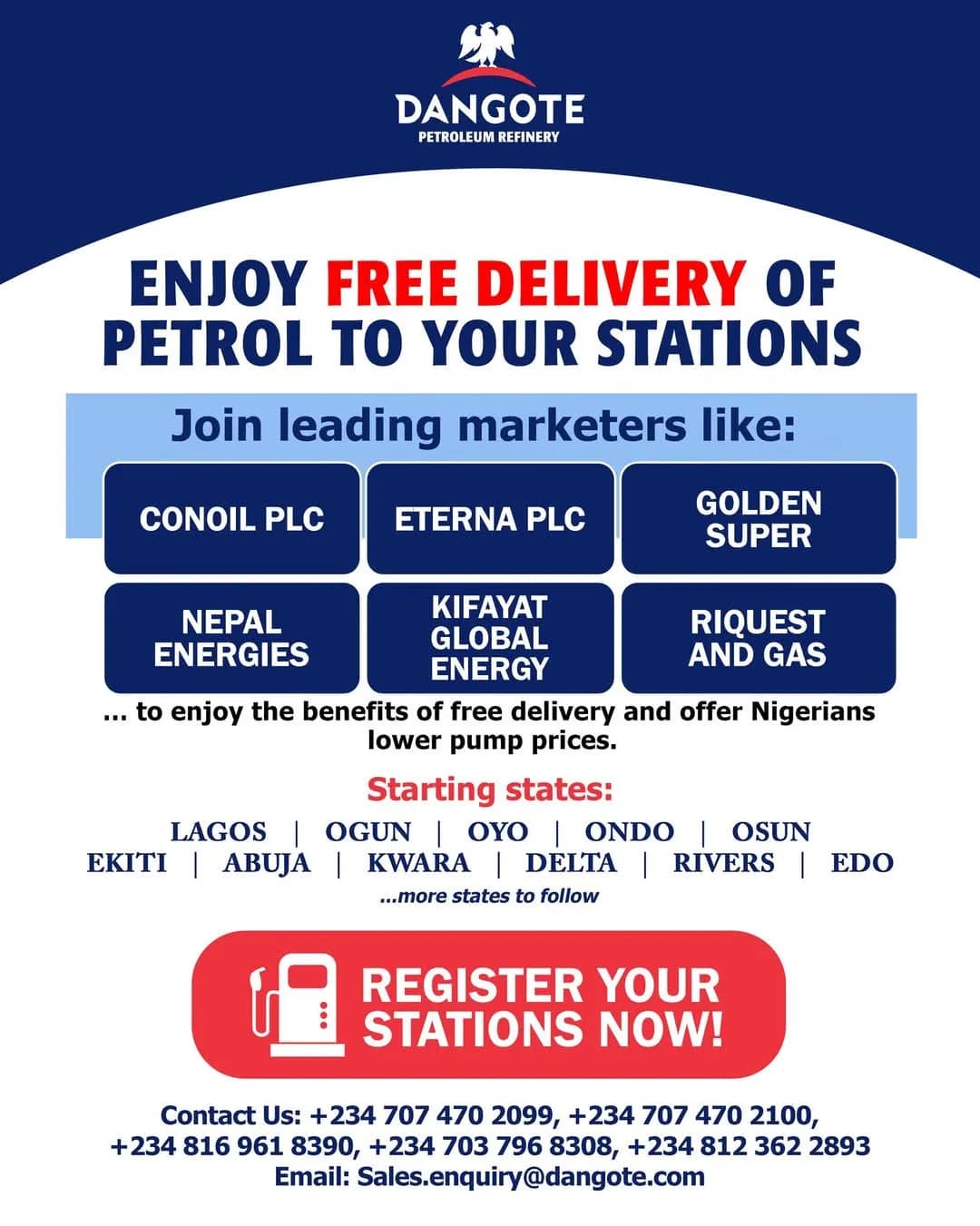
Nigeria’s downstream oil market is entering a new era. Conoil PLC, Eterna PLC, and other major players have joined hands with Dangote Refinery to roll out a free fuel delivery scheme that is already shaking the foundations of the country’s petroleum logistics system.
Breaking the Chain of Middlemen
For years, the cost of transporting fuel from depots to filling stations has piled heavy charges on motorists. Tanker operators and depot middlemen turned logistics into a profit centre, often at the expense of final consumers. But Dangote Refinery, with its 650,000-barrel-per-day facility in Lekki, is rewriting the rules.
By introducing over 1,000 compressed natural gas (CNG)-powered trucks, the refinery is cutting out third-party costs and delivering petrol directly to stations at zero logistics fees. This bold move not only reduces distribution bottlenecks but also signals a structural shift in Nigeria’s downstream sector.
Marketers Embrace the New Model
Dangote’s model is quickly attracting top marketers. Conoil PLC, Eterna PLC, Golden Super, Nepal Energies, Kifayat Global Energy, and Riquest and Gas have already signed on. The programme, which begins in 11 states including Lagos, Abuja, Ogun, Oyo, Rivers, and Delta, promises to make fuel cheaper and more accessible.
For filling station operators, the attraction is simple: lower costs, faster deliveries, and direct refinery access. For consumers, it raises hopes of reduced pump prices at a time when inflation is eroding household incomes.
Rising Tensions in the Transport Sector
But the free-delivery model is not without losers. The National Association of Road Transport Owners (NARTO) has raised red flags, warning that its 30,000 trucks risk being pushed out of business.
NARTO President, Yusuf Othman, explained that many members obtained bank loans based on existing haulage contracts with oil marketers. Those agreements are now under threat as stations and bulk buyers abandon them for Dangote’s cost-free option.
“If I sign an agreement with you to move products using my 10 trucks, and someone else suddenly offers to do it for free, that contract is dead on arrival,” Othman argued, calling on regulators to intervene.
NARTO cites Section 212 of the Petroleum Industry Act (PIA) and insists that Dangote’s direct-to-station supply model amounts to an ‘illegal act’ that undermines licensed operators.
A Calculated Disruption
Analysts see this not just as a generosity-driven policy but as a market penetration strategy. By absorbing logistics costs, Dangote secures loyalty from retailers, consolidates control of the supply chain, and pressures competitors to adjust their models.
In industry terms, this is vertical integration at its boldest: the refinery is not only producing fuel but also dictating how it reaches the market. The use of CNG trucks further positions Dangote as a promoter of cleaner and cheaper energy transport, subtly aligning with the government’s energy transition agenda.
What It Means for Nigerians
Consumers are promised immediate relief, lower pump prices and stable supply. For smaller marketers, it levels the playing field, allowing them to compete without being strangled by logistics costs. For transport operators, however, it poses an existential crisis.
The federal government and the Nigerian Midstream and Downstream Petroleum Regulatory Authority (NMDPRA) may soon intervene, either to protect competition or to endorse the new order as the inevitable future of the downstream market.
The Road Ahead
Nigeria is watching history unfold in its oil sector. If Dangote’s free fuel delivery model gains momentum, it could permanently alter supply dynamics, displace traditional logistics providers, and redefine consumer pricing.
One thing is certain: this is more than just a refinery initiative, it is a strategic disruption that could reshape how petrol flows from plant to pump across the country.