

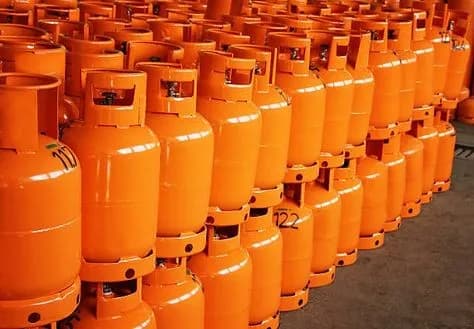
For months, Nigerians watched cooking gas prices climb relentlessly, draining household budgets and forcing many families back to firewood, charcoal and kerosene. By November 2025, the price of liquefied petroleum gas (LPG) had crossed psychological and economic breaking points in several cities, selling for as much as ₦2,000 per kilogram and above.
Then, quietly but steadily, the tide began to turn.
Findings by a petroleumprice.ng correspondent, who conducted market checks and spoke with LPG retailers, plant operators and consumers across key urban centres, show that cooking gas prices have stabilised sharply in early January 2026, offering rare relief in a market long known for one-way price movements.
As of January 10, 2026, LPG is selling for ₦1,000 to ₦1,400 per kilogram nationwide, depending on location, logistics and seller margins. This marks a decisive pullback from the extreme volatility that defined the final quarter of 2025.
Lagos Leads the Price Reset as Supply Normalises
Lagos, Nigeria’s largest LPG consumption hub, is at the centre of the price correction.
Market surveys conducted by petroleumprice.ng across Apapa, Ajegunle, Ikeja, Surulere, Yaba, Mushin and Lekki show that prices vary largely based on proximity to depots and filling plants. Areas closer to Apapa and Creek Road, where several LPG terminals and storage facilities are located, continue to enjoy the lowest prices.
At major plants and direct-sale outlets around Apapa, Wharf Road and Coconut axis, LPG is selling for between ₦950 and ₦1,050 per kg, while neighbourhood retailers in places such as Ikeja, Surulere and Yaba sell between ₦1,250 and ₦1,400 per kg, reflecting transport and handling costs.
On average, a 12.5kg cylinder now refills for ₦12,500 to ₦17,500 in Lagos, down sharply from over ₦20,000–₦25,000 recorded at the height of the late-2025 scarcity.
Similar pricing trends were observed in Ogun and Oyo states, which benefit from Lagos-linked supply routes, while prices in the South-South, including Port Harcourt and parts of Delta, have also settled within the national band.
Inside the Market Forces Driving the Price Drop
Interviews conducted by petroleumprice.ng with LPG retailers and industry sources point to a clear supply-side correction as the primary driver of the price decline.
The market disruptions that plagued September and October 2025—particularly industrial disputes involving petroleum sector unions—have been resolved, allowing normal operations to resume across gas handling, trucking and coastal distribution channels.
At the same time, Nigeria LNG Limited (NLNG) has sustained strong domestic LPG supply volumes. NLNG, which accounts for over 40 per cent of Nigeria’s LPG consumption, continues to shuttle cargoes from Bonny Island to Lagos and Port Harcourt terminals, significantly reducing dependence on high-cost imports.
Globally, softer LPG prices linked to oversupply and weaker seasonal demand have also eased landing costs for Nigerian importers. Although global gluts do not always translate directly into local price relief, improved distribution efficiency and fewer disruptions have allowed domestic prices to finally adjust downward.
A relatively steadier naira and calmer downstream logistics have further reduced speculative pricing, bringing a measure of discipline back into the market.
Relief, Caution and Lingering Anger
As petroleumprice.ng findings circulated, reactions from Nigerians on social media platform X (formerly Twitter) reflected a mix of relief, disbelief and cautious optimism.
Reacting to the price drop, @Naija_PR wrote:
“This is the first time in Nigeria history wey price of things will go up and come down. This man here is not getting enough accolades.”
Recalling the recent hardship, @abazwhyllzz said:
“Gas is 2100 per kilo… and everyone in the country is doing as if everything is okay?”
Some Nigerians welcomed the relief but noted that affordability remains relative. @the5actor posted:
“Last I bought gas was 1k per litre equivalent. Things are really expensive in Nigeria, but this drop is a relief.”
Others were less forgiving. @omoseelevel compared current prices with past decades, saying:
“Remember when cooking gas was ₦250 per kg? Even at ₦1,200, it’s still expensive for many families.”
There were also broader questions about market structure. @nwabuisi1 asked:
“Why is cooking gas (LPG) still expensive in Nigeria despite a global LNG glut?”
Relief, But Not Yet a Victory
Energy analysts who spoke with petroleumprice.ng say the current stability represents a market correction, not a structural fix. While prices may remain steady in the short term, Nigeria’s LPG market is still exposed to currency swings, logistics bottlenecks and policy shocks.
Sustained investments in storage infrastructure, coastal distribution, cylinder penetration and last-mile delivery will be critical to preventing another price spiral.
For now, however, the early-2026 LPG price reset stands out as a rare moment in Nigeria’s energy market, proof that prices can fall when supply is allowed to work. For millions of households, that alone is a welcome change.