

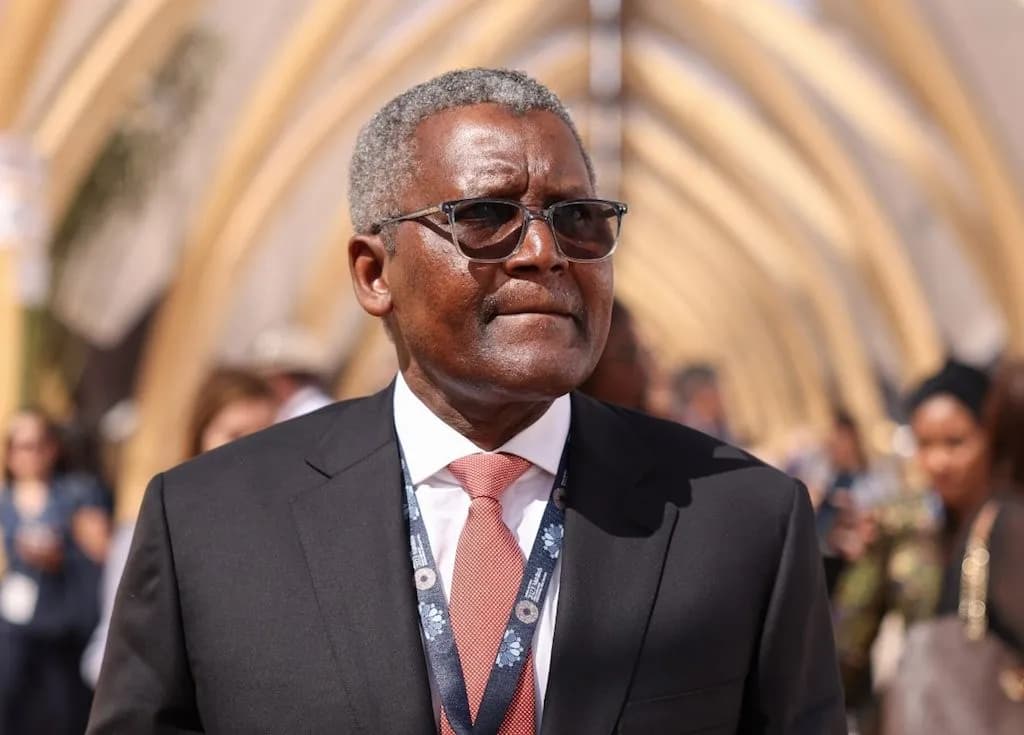
Aliko Dangote has challenged Nigeria’s official petrol consumption data, accusing powerful interests of inflating figures to profit from fuel subsidies. He said Nigeria’s actual fuel usage is much lower than the government claims and argued that corruption, not consumption, drives the numbers.
During a visit by Global CEO Africa delegates to the Dangote Refinery in Lagos, the billionaire industrialist criticized long-standing manipulation in the sector and described the oil trade as a “mafia business.”
“Nigeria Doesn’t Use That Much Petrol”
According to Dangote, the country consumes about 33 million litres of petrol daily—far below the 50 million litres quoted by regulators. He claimed officials previously inflated demand up to 90 million litres to justify subsidy payments and enrich themselves.
“We don’t have enough vehicles to support that number,” he said. “The inflated figures came from subsidy-era profiteering. Real daily consumption is closer to 33 million litres.”
The Nigerian Midstream and Downstream Petroleum Regulatory Authority (NMDPRA) reported in 2023 that consumption peaked at 66 million litres per day. After the subsidy ended in May 2023, the agency said the figure dropped to between 45 and 50 million litres.
Dangote rejected that data and said diesel demand stands at 10 million litres per day, not the 14 million litres NMDPRA suggests. He also noted that Nigeria uses just 3 million litres of aviation fuel daily.
His refinery, he explained, produces 104 million litres of refined fuel daily. Of this, only 46 million litres are needed to meet local demand, leaving 58 million litres for export.
Marketers Agree on Corruption, Disagree on Volumes
The Independent Petroleum Marketers Association of Nigeria (IPMAN) backed Dangote’s claim that the industry suffers from corruption. However, it said daily fuel use varies by season and cannot be pinned to a single number.
IPMAN spokesman Chinedu Ukadike noted that fuel demand dropped after the subsidy removal and the expansion of compressed natural gas (CNG) adoption. He recalled that NMDPRA told marketers last year that daily petrol use had fallen from 70 million to 50 million litres.
“Our concern is product availability,” Ukadike said. “Whether it’s 35 or 50 million litres, we must keep the supply flowing nationwide.”
He added that smuggling has declined thanks to tighter security, and current demand likely sits around 40 million litres per day.
Refiners Call for Independent Consumption Audit
The Crude Oil Refiners Association of Nigeria (CORAN) said Nigeria needs an independent review to establish accurate fuel consumption figures. Spokesman Eche Idoko suggested that the National Bureau of Statistics should lead that assessment.
“Until we get objective data, these debates will continue,” Idoko said. “The regulator tracks loading and sales, but can’t verify if all the fuel is consumed locally. With porous borders and smuggling, that’s hard to prove.”
He noted that Dangote, as a producer, has its own data, while the regulator offers a broader sector view. Only independent findings, he said, can settle the disagreement.
A History of Conflict with Regulators
Dangote and NMDPRA have clashed before. Last year, Dangote accused the agency of licensing the importation of “dirty” fuel, undermining his refinery’s efforts to provide cleaner alternatives. NMDPRA head Farouk Ahmed responded by claiming Dangote’s diesel had a higher sulphur content than imported products.
Ahmed also said the refinery wasn’t fully licensed at the time. He argued that imported fuels complied better with West African sulphur standards than Dangote’s output, drawing sharp criticism for seemingly demarketing local refineries.
Dangote challenged the agency to test his diesel in any independent lab. He insisted his refinery produces the cleanest fuel in Nigeria and said most importers rely on fake quality certificates from compromised testing labs.
“Our fuel is of the highest standard,” he said. “If the regulator doubts it, they should compare both products and let Nigerians see the results.”
Fuel Import Debate Reignites
Earlier this year, Dangote again clashed with the NMDPRA after it claimed Nigeria’s refineries could only meet 50% of local fuel demand. Dangote pushed back, insisting his refinery can meet the full national need and still export more than half of its output.
“We have over half a billion litres of fuel in stock,” he said. “That’s more than enough to meet Nigeria’s demand. There’s no need for further imports.”
He argued that inflated demand figures exist only to justify continued fuel importation. He called on authorities to end foreign purchases and rely on local supply instead.
“Stronger Than the Drug Cartel”
Dangote also revealed that powerful domestic and international forces attempted to stop his $20 billion refinery project. He described the petroleum sector as more corrupt and dangerous than the drug trade.
“The oil mafia is stronger than the drug mafia,” he said during an earlier speech in The Bahamas. “They tried everything to stop us—but I’ve spent my life fighting battles like this.”
He accused unnamed global and local players of working together to undermine the refinery’s launch and preserve their grip on fuel imports.
Looking Ahead
As Dangote intensifies his challenge to the status quo, Nigeria faces a pivotal moment in its downstream energy sector. With a world-class refinery now operational, attention is turning to whether the country will break free from import dependence or continue to protect entrenched interests.
Dangote’s push for transparency and domestic supply has brought long-standing contradictions into sharp focus. The path forward, many say, now depends on whether regulators are willing to embrace reform or defend the old order.