

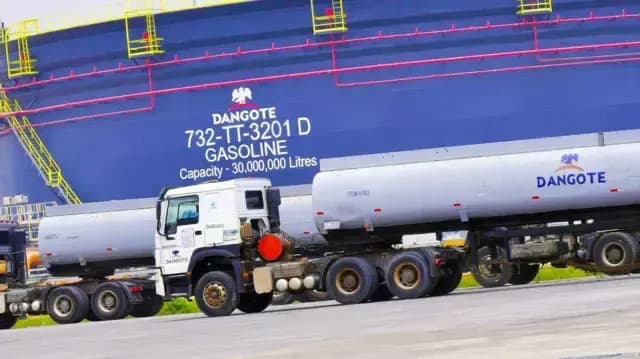
Dangote Refinery has activated a new structured loading model that allocates 25 per cent of product volumes through gantry operations and 75 per cent via coaster vessels to its newly approved depot owners, an industry source told Petroleumprice.ng.
The arrangement forms the backbone of the refinery’s revised supply framework, which limits direct lifting to a 14-member consortium of approved depot operators.
Large-Scale Volume Commitments Begin
Sources indicate that the 14 approved depot owners have already commenced payments under the new deal, with most committing to volumes of 100 million litres and above.
Several members are reportedly securing allocations exceeding 200 million litres, while only a few are operating at lower thresholds of around 50 million litres. The bulk commitments signal a deliberate shift toward high-volume, structured trading.
Under the agreement, gantry pricing at the refinery level remains unchanged at ₦774 per litre. However, depot owners will now assume greater responsibility for managing downstream pricing and market coordination.
Controlled Access and Market Structure
The refinery will sell exclusively to the approved consortium members under the current framework. Industry insiders say the objective is to introduce a stronger structure into petroleum trading by consolidating supply among operators with storage capacity, distribution networks, and financial depth.
Depot owners are expected to determine ex-depot prices, a move seen as positioning them to moderate volatility and guide market benchmarks.
Grace Period for Previous Buyers
Meanwhile, marketers who lifted products under the earlier arrangement have been granted a two-day grace period to clear outstanding volumes. The window, which closes tomorrow, is designed to allow a full transition into the new depot-driven structure.
Sources say the refinery is seeking to “sanitise” the supply chain by formalising participation thresholds and eliminating fragmented spot purchases.
The revised allocation model underscores Dangote’s continued effort to centralise distribution, strengthen coordination, and stabilise pricing in Nigeria’s downstream petroleum market.