

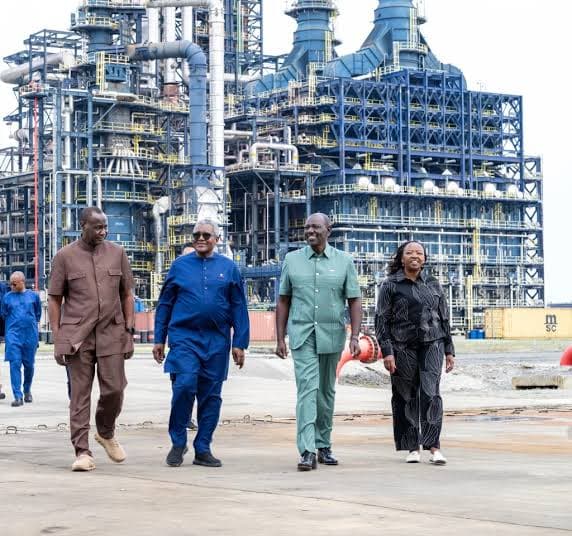
Dangote Group has commenced construction of a 700,000 barrels-per-day refinery in Lamu, Kenya, marking another major expansion of the Nigerian conglomerate’s refining ambitions across Africa and setting a 40-month target for commissioning the $16 billion project. The facility is designed to reduce Kenya’s dependence on imported refined petroleum products while serving the wider East African and international markets.
The project, located in Mokowe in Kenya’s Lamu County, follows Dangote’s earlier indication that construction would take about three years. According to Argus, basic engineering work is already about 70% complete, while construction equipment has started arriving at the site. A further 400 pieces of equipment are expected over the next two months, with soil investigations continuing and site development and fencing scheduled to begin next month.
The scale of the refinery is significant for a region that remains heavily dependent on imported petroleum products. Kenya spent about 330 billion Kenyan shillings ($2.55 billion) on oil product imports last year, while Kpler data cited by Argus showed the country imported about 68,000 b/d of gasoline and 90,000 b/d of diesel and gasoil. The new refinery is therefore being positioned as a strategic supply source for Kenya and neighbouring East African markets.
Kenyan President William Ruto said the $16 billion investment is expected to boost the country’s economy and attract foreign investment during the construction phase. He also linked the refinery to the development of the Lamu Port-South Sudan-Ethiopia Transport (Lapsset) corridor, with the project intended to support the emergence of Lamu as a major industrial hub.
Beyond conventional refining, the complex is planned to include a 1,000MW power-generation facility, a base oils plant and a polypropylene unit. Its power capacity would be twice that of Dangote’s 700,000 b/d refinery in Lagos, with part of the electricity expected to be supplied outside the refinery complex.
Crude supply will be a key consideration for the project. Most of the refinery’s feedstock will have to be sourced from outside Kenya, while the country’s South Lokichar basin is expected to begin producing about 20,000 b/d of crude before December, according to Kenya’s oil minister cited by Argus. The relatively limited domestic crude supply means the refinery’s long-term operations will depend substantially on reliable regional and international crude logistics.
Dangote also plans to offer East African countries a combined equity stake of up to 30% in the Lamu project. Kenya will take a stake in the refinery and petrochemical complex, while Kenyan investors are expected to have an opportunity to acquire shares through the Nairobi Securities Exchange.
The refinery is also being positioned as an export-oriented project. Kenya says the facility will serve the wider East African market and international customers, while Dangote has indicated that the UK and European Union could potentially source part of their jet-fuel requirements from the refinery. This broadens the project’s significance beyond Kenya’s domestic fuel market and places it within the wider competition for refined-product supply across Africa and international markets.
However, the project faces legal and development-related issues. President Ruto criticised a court order affecting the project, although Argus reported that further details of the order and the construction work it covers were not immediately available. The project’s progress will therefore remain subject not only to construction execution and financing but also to the resolution of outstanding legal and site-related matters.
With commissioning targeted in 40 months, the Lamu refinery represents a major new refining capacity addition for East Africa. If delivered on schedule, its 700,000 b/d capacity would materially change the region’s refined-product supply landscape and strengthen Dangote Group’s position in Africa’s rapidly developing refining and downstream market.