

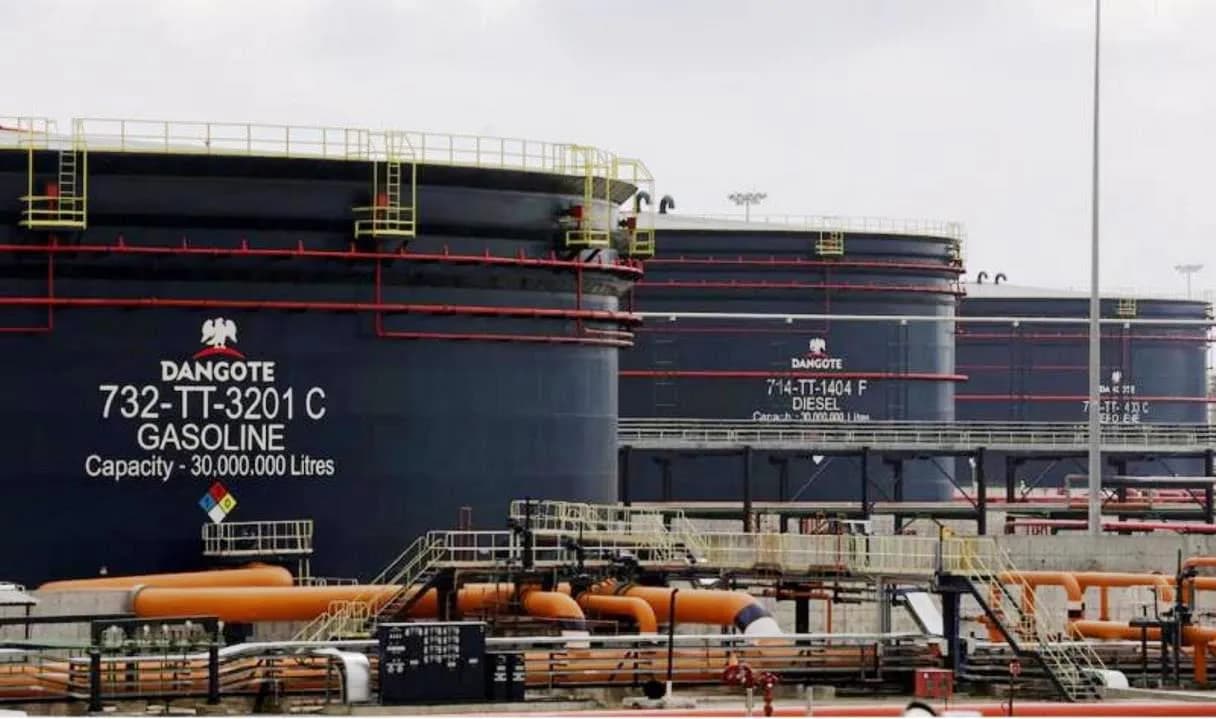
The Dangote Petroleum Refinery has officially suspended its discounted fuel pricing scheme following revelations of systemic abuse by affiliated marketers. Investigations uncovered that several partners diverted discounted products for private profit, compromising the integrity of the programme and disrupting downstream market dynamics.
Scheme Exploited by Marketers
Internal racketeering has compromised the initiative aimed at helping strategic partners keep pump prices affordable. Some registered marketers reportedly sold their Authority to Collect (ATC) tickets to external traders who lack official registration with the refinery.
Instead of supplying fuel to retail outlets, these marketers redirected truckloads of Premium Motor Spirit (PMS) to third-party depots. This enabled them to sidestep operational costs while earning quick profits from price differentials, leaving end consumers exposed to market fluctuations.
Internal Memo Confirms Immediate Suspension
A circular dated July 13, 2025, and signed by Fatima Dangote, the Group Executive Director (Commercial Operations), confirmed the suspension. It cited persistent complaints and flagrant resale of products at the refinery tarmac below the approved gantry rate, an actions that threaten the sustainability of the refinery’s pricing model.
“Despite several engagements, these violations have continued unchecked,” the letter stated. “We are pausing the discount scheme while we restructure the system for transparency and efficiency.”
Credit-Backed Products Also Misused
In addition to ATC abuse, industry experts confirmed misuse of volume-based credit allocations. The refinery had previously allowed marketers to receive additional fuel volumes beyond their payments intended to guarantee national supply under a pay-later arrangement. However, many recipients resold these bonus allocations to independent marketers instead of distributing them through assigned filling stations.
“This scheme was meant to boost circulation,” noted oil analyst Olatide Jeremiah. “But instead, some marketers sold these volumes outside the chain to maximise profit, ignoring their retail obligations.”
Concessions for Valid Orders
Despite the clampdown, Dangote Refinery assured that all valid Product Release Notes (PRNs) generated before the cut-off date will still be honoured. Marketers who had completed payments by July 13 will receive their product allocations at the agreed discounted rates.
It further instructed partners to maintain consistency in pump pricing and adhere to approved price bands across all service stations.
Depot Reactions and Market Trends
Field data gathered shows that several non-affiliated depots have adjusted their pricing structures to mirror Dangote’s revised benchmark. Last week, five independent depots reduced ex-depot rates to ₦820/litre down from ₦835 aligning closely with Dangote’s last official price, even without subsidy access.
Major Partners Under Watch
Though Dangote Group has not released the names of defaulting marketers, industry sources list partners including MRS Oil, Ardova Plc, Heyden Petroleum, TotalEnergies, Optima Energy, Hyde Energy, and Techno Oil among those involved in the broader supply framework.
When contacted, the Group Head of Corporate Communications, Anthony Chiejina, confirmed the issue was under internal review and denied any external conflicts between the refinery and its partner marketers.
Programme May Return in New Format
The refinery clarified that the strategic partner framework remains intact but will undergo a complete overhaul. Officials are currently considering stricter loading protocols, digital tracking of ATCs, and possible introduction of loyalty-linked rewards to discourage exploitation.
“The goal isn’t to end partnerships but to ensure fairness, compliance, and sustainability,” the refinery’s internal memo added.
As Nigeria’s energy landscape shifts toward local refining and market-led pricing, this episode underscores the challenges of regulating new entrants in a partially liberalised fuel supply system. For the Dangote Refinery, credibility and operational discipline may prove just as crucial as scale in its long-term bid to stabilise the Nigerian downstream sector.