

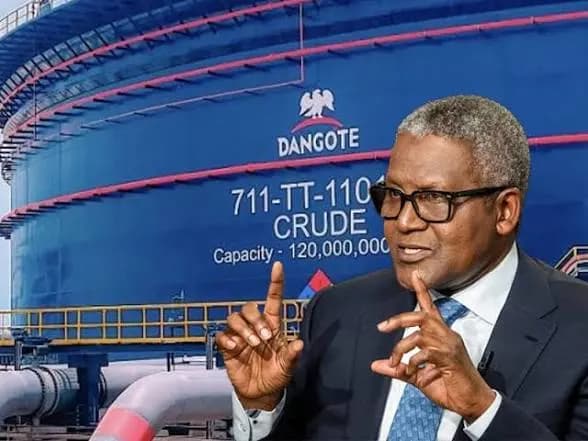
Aliko Dangote is moving to extend his refining footprint across Africa, with plans to establish a new 650,000 barrels-per-day refinery in East Africa, a project that could significantly reshape the region’s fuel supply landscape.
Speaking at the Africa We Build Summit in Nairobi, the Dangote Group President said the company is prepared to replicate the scale and operating model of its Lagos refinery, provided East African governments create the right policy environment and commit to supporting the investment.
The proposed facility aligns with ongoing discussions among Kenya, Uganda and Tanzania to develop a regional refining hub in Tanga. If delivered, the refinery would process crude from across East and Central Africa, including supplies from South Sudan and the Democratic Republic of Congo, helping to reduce the region’s dependence on imported petroleum products.
Dangote said his confidence in the project rests on proven execution. Having successfully delivered Africa’s largest refinery in Nigeria, he believes the same model can be deployed elsewhere on the continent.
“If the governments support the refinery, we will build the identical one that we have in Nigeria, a 650,000 barrels-per-day refinery. We have done it before, and that is why we are taking this bold step again,” he said.
He also revealed that expansion work has already commenced at the Lagos refinery, where capacity is being scaled from 650,000 barrels per day to 1.4 million barrels per day. At that level, the complex would rank among the largest refining centres in the world.
Beyond the refinery itself, the project carries broader strategic value. It would deepen Africa’s refining capacity, strengthen regional energy security, reduce exposure to global supply disruptions and unlock fresh investment opportunities across the downstream value chain.
For a region that still imports the bulk of its refined fuel, the planned refinery represents more than infrastructure. It is a decisive step towards energy independence, industrial growth and a more resilient African petroleum market.