

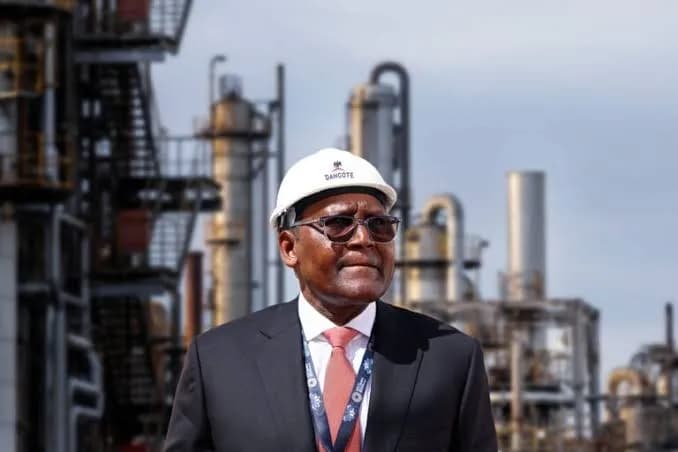
Aliko Dangote has dismissed any hope of reviving Nigeria’s moribund state-owned refineries, declaring the $18 billion spent on them a monumental waste. During a high-level visit to his 650,000 bpd Dangote Refinery in Lekki, the billionaire industrialist challenged the credibility of government-backed rehabilitation efforts and questioned the rationale for keeping the outdated facilities on life support.
State Refineries “Beyond Recovery”
Dangote, while briefing the Global CEO Africa delegation from Lagos Business School, stated flatly that the refineries in Port Harcourt, Warri, and Kaduna can no longer operate efficiently if at all. He likened recent maintenance efforts to “modernising a 40-year-old car with obsolete parts,” noting that the infrastructure is far too antiquated to meet modern refining standards.
“They’ve poured $18 billion into those refineries, and nothing works. It’s a bottomless pit,” Dangote said bluntly.
He revealed that the Dangote Group had legally acquired the refineries in 2007 under then-President Olusegun Obasanjo, only for the transaction to be reversed by Obasanjo’s successor, Umaru Yar’adua, following internal objections by NNPC executives. According to Dangote, the officials argued the sale was undervalued, a claim he believes was politically motivated and economically irrational.
Obasanjo Echoes Concerns, Calls It a Corruption Cover
Dangote’s frustration mirrors that of former President Olusegun Obasanjo, who last year accused NNPC of retaining the refineries merely to facilitate corruption. According to Obasanjo, international oil majors, including Shell, refused to operate the assets due to their poor condition.
“NNPC couldn’t run them. They just kept them for the corruption,” Obasanjo said, adding that the facilities, now dilapidated, wouldn’t fetch more than $200 million as scrap.
He also confirmed that Dangote paid $750 million to acquire the assets in 2007, a deal Yar’adua scrapped despite regulatory clearance.
Repeated Failures Undermine Public Trust
Despite multiple Turnaround Maintenance (TAM) interventions, none of the refineries has returned to sustainable operation. Port Harcourt’s 60,000 bpd unit resumed briefly in late 2024, only to shut down six months later. Warri reopened in December 2024 and lasted just one month. Kaduna remains idle.
Major Government Investments into TAM
| Refinery | Project | Cost |
|---|---|---|
| Port Harcourt | 2021 rehabilitation | $1.4 billion |
| Warri | 2021 upgrade | $897 million |
| Kaduna | 2021 maintenance | $586 million |
| 3 Refineries | TAM (2013–2017) | $396.33 million |
| 3 Refineries | Extra funding (2021) | ₦100 billion + ₦8.3bn/month |
Despite this, Nigeria continues to import nearly all its refined petroleum products, including petrol, diesel, and jet fuel.
Dangote Refinery Shifts Paradigm
In contrast to government paralysis, Dangote’s $19 billion refinery has already begun refining operations and currently channels over 50% of its production into Premium Motor Spirit (PMS). This sharply contrasts with the combined 22% PMS yield recorded from government refineries during their last operational years.
“Aliko will make it work and deliver,” Obasanjo affirmed. “Unlike NNPC, which claims harvests it never planted.”
His metaphor cut deep: “They plant 100 heaps of yam but claim 200, leaving 100 heaps of lies.”
Analysts Demand Bold Action: Privatise or Scrap
The continued failure of Nigeria’s state-owned refining assets has reignited calls for privatisation. Industry stakeholders including the Manufacturers Association of Nigeria (MAN) argue that retaining the refineries is economically unjustifiable. Some suggest auctioning them off for scrap to fund modular refinery projects, which are more efficient and flexible.
“The government needs to divest. This isn’t about politics—it’s about economic survival,” said a downstream policy analyst at NextOil Consultancy.
Analysts estimate that the refineries have cost Nigeria billions in lost revenue, excessive fuel import bills, and untapped job creation opportunities. The longer they remain under state control, the greater the economic leakage.
NNPC Silent on Criticism
Efforts to obtain a response from the Nigerian National Petroleum Company Limited (NNPC) were unsuccessful. The phone lines listed on the company’s website went unanswered, and no official statement had been released as of press time.
Final Thoughts
Dangote’s remarks have thrown fresh spotlight on the inefficiency of state-run refining operations and exposed the long-term costs of political interference in strategic assets. As his Lekki refinery scales output, it offers Nigeria a credible alternative but the broader industry still demands regulatory reform, transparency, and an honest conversation about asset divestment.