

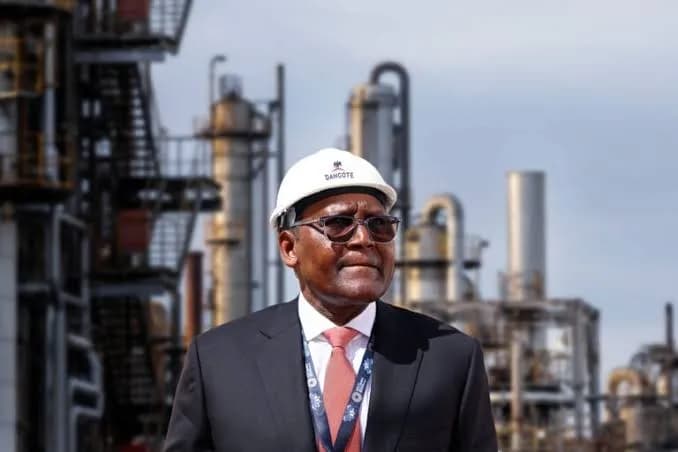
Nigeria’s push to escape decades of fuel dependence is stumbling. Soaring import bills now collide with Dangote Refinery’s increasing reliance on foreign crude.
In the first half of 2025, the Lagos-based plant imported about 60 million barrels of crude oil, Aliko Dangote said. Meanwhile, official data showed Nigeria spent more than ₦4 trillion on petrol imports, highlighting the depth of the challenge.
Refinery Forced Offshore for Supply
At the West African Refined Fuel Conference in Abuja, Dangote revealed that the refinery buys 9–10 million barrels of crude every month from the US and other suppliers. Analysts argue this reflects Nigeria’s failure to guarantee local feedstock, since the Nigerian National Petroleum Company (NNPC) often prioritises export sales that bring in foreign exchange.
The irony is clear: a refinery built to end imports now depends on international markets to run.
Import Bill Balloons
Figures from the National Bureau of Statistics (NBS) showed that petrol imports cost ₦2.3 trillion in Q2 2025, up from ₦1.76 trillion in Q1. As a result, total spending for the half-year hit ₦4.06 trillion. Petrol ranked among Nigeria’s top imports, alongside wheat, gas oil, crude petroleum, and sugar.
Moreover, when all “mineral fuels” are included, Q2 imports reached ₦4.42 trillion—nearly 29% of Nigeria’s total import basket. Machinery, transport equipment, and chemicals followed at lower values.
Ports Under Pressure
Trade data also underscored Nigeria’s reliance on Lagos ports. In Q2, Apapa processed nearly ₦18 trillion in exports and ₦7 trillion in imports, far ahead of Lekki Deep Sea Port and Tin Can Island. This dependence has fueled congestion and higher costs. However, the government has promised to expand capacity at other ports to ease the burden.
OPEC Output at Five-Month Low
Nigeria’s crude oil production under OPEC rules slipped to 1.43 million barrels per day in August, its lowest in five months, according to the cartel. The figure excluded condensates, which added about 204,000 bpd in July. Nevertheless, Nigeria still held its position as Africa’s top producer, ahead of Libya and Algeria.
Promise Yet to Be Fulfilled
The Dangote Refinery was hailed as a game-changer that would stabilise pump prices, save foreign exchange, and deliver energy security. Yet, nine months into 2025, imports remain high, crude supply remains shaky, and Nigeria’s long-promised self-sufficiency is still out of reach.