

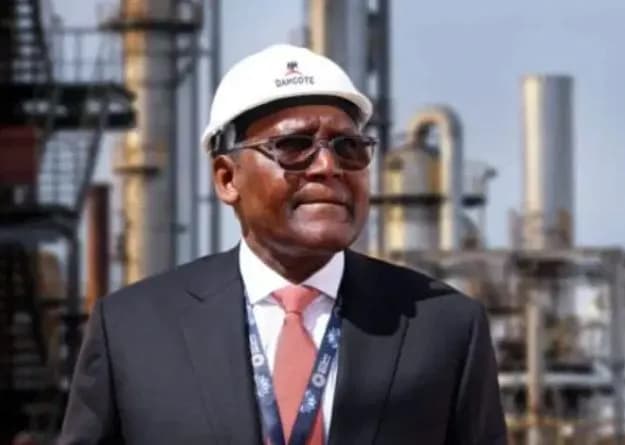
In a strategic shift poised to disrupt Nigeria’s Liquefied Petroleum Gas (LPG) value chain, Africa’s richest man, Aliko Dangote, announced plans to slash cooking gas prices and warned of bypassing traditional distribution channels if marketers fail to comply with the refinery’s pricing framework.
Speaking during a facility tour with the Lagos Business School’s CGEO Africa delegation at the $20 billion Dangote Petroleum Refinery in Lekki on July 15, 2025, Dangote stressed the urgent need to make LPG affordable for low-income households as the country grapples with rising energy poverty.
“We are working to cut LPG prices. If distributors resist, we’ll sell directly to consumers,” Dangote declared. “Our refinery produces 2,000 tonnes of LPG daily we want every Nigerian to afford clean cooking fuel.”
Industry Context: Gas Demand vs Access Gaps
The move comes amid widespread complaints over surging LPG retail prices, which have forced many Nigerians particularly in peri-urban and rural areas to revert to firewood and kerosene. According to data from the National Bureau of Statistics, over 65% of Nigerian households still lack consistent access to clean cooking fuel. Meanwhile, the World Health Organization attributes more than 95,000 deaths annually in Nigeria to indoor air pollution linked to biomass usage.
By leveraging its high-yield LPG output, the 650,000 bpd Dangote Refinery, Africa’s largest single-train facility, seeks to close Nigeria’s affordability gap in the downstream gas market where retail prices often reflect multi-tiered distribution markups, poor infrastructure, and FX volatility.
Distributors on Alert as Refinery Ramps Up Output
Dangote’s warning has rattled established LPG marketers and distributors, many of whom rely on import-dependent supply chains and fragmented logistics. His statement signals a possible vertical integration strategy where the refinery could cut out intermediaries, introducing a manufacturer-to-consumer (M2C) supply model that would upend conventional pricing and distribution.
Industry analysts say while the plan could lower household costs, it also threatens existing players who operate on thin margins in a price-sensitive market.
“This is a wake-up call to marketers inflating prices,” said one Lagos-based downstream consultant. “If Dangote executes direct sales at scale, he could reshape Nigeria’s entire LPG architecture.”
A Market-Changing Development
The 2,000 tonnes/day LPG output at Dangote’s facility, if efficiently distributed, has the potential to meet over 60% of Nigeria’s average daily demand, currently estimated at 3,200 tonnes. This scale, analysts argue, positions the refinery as a pivotal player in stabilising prices, deepening market penetration, and displacing legacy supply bottlenecks tied to imports.
Moreover, LPG affordability aligns with Nigeria’s Decade of Gas initiative, which targets widespread domestic utilisation of gas for cooking, transport, and industrial use.
The Ministry of Petroleum Resources has in recent months highlighted the importance of LPG in mitigating deforestation and reducing carbon emissions challenges worsened by the return to firewood in low-income areas.
What’s Next?
With Dangote’s declaration now in the public arena, downstream stakeholders are bracing for a possible regulatory realignment. The Nigerian Midstream and Downstream Petroleum Regulatory Authority (NMDPRA) may soon step in to define fair pricing mechanisms, storage rights, and end-user protections if direct-to-consumer models emerge.
For now, consumers and small-scale LPG retailers await the next move from Nigeria’s largest privately-owned refinery. Will Dangote disrupt the gas market as he did with cement? If pricing momentum builds, Nigerians may soon experience a structural shift in energy access, one cylinder at a time.