

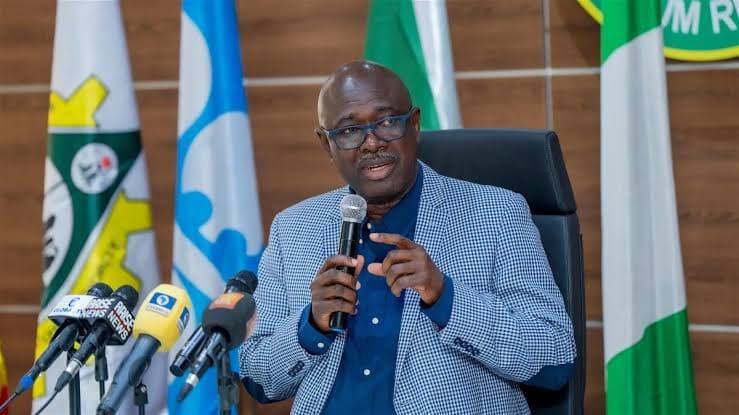
The Federal Government has said Nigeria will need substantially more refining capacity and supporting infrastructure to meet Africa’s growing demand for refined petroleum products, stressing that the Dangote Petroleum Refinery, despite its scale, cannot by itself satisfy the continent’s requirements.
Minister of State for Petroleum Resources (Oil), Heineken Lokpobiri, made the position clear on Tuesday at the second West Africa Refined Fuel Market Conference in Abuja, where he called for increased private investment across Nigeria’s refining, midstream and downstream sectors.
Lokpobiri said the Dangote refinery had demonstrated the potential of large-scale private investment in Nigeria’s petroleum industry, but argued that even an expansion of its capacity to 1.4 million barrels per day would remain insufficient for the African market.
“The Dangote refinery is not enough. Despite the fact that the refinery is increasing its refining capacity to 1.4 million barrels. But it is not enough for the African continent,” the minister said.
He therefore urged investors to take advantage of Nigeria’s expanding energy market by committing capital not only to refining but also to pipelines, storage, transportation and other infrastructure required to move petroleum products efficiently across the continent.
Lokpobiri said Nigeria’s strategic position and its relatively limited exposure to supply disruptions through the Strait of Hormuz further strengthened the case for developing the country into a major regional energy hub.
“It’s the best time for us to attract as many investors as we can. Not just into the upstream, but into the midstream, and then the downstream,” he said.
The minister said Nigeria must also move away from a model in which the country exports raw commodities and imports processed products. He argued that increasing domestic refining and processing capacity would allow Nigeria to capture a larger share of the value generated within the African market.
He said the success of the Dangote refinery should therefore be replicated through additional investments, stressing that Nigeria’s ambition should extend beyond supplying West Africa to serving the wider continent.
“Africa has a huge market, and I believe that the time has come for Nigeria as the leader of the oil and gas industry in Africa to be a true leader,” Lokpobiri said.
He linked the success of that ambition to the development of a sustainable petroleum pricing mechanism capable of attracting investment while allowing market forces to determine product prices. He said this was one of the reasons the conference was important.
Special Adviser to the President on Energy, Olu Verheijen, reinforced the argument, saying refining capacity alone would not guarantee energy security. She said products must also be financed, stored, transported and distributed efficiently.
“Refining capacity alone, as big as ours is, does not create energy security,” Verheijen said, calling for investment in pipelines, ports, storage facilities, coastal vessels, trucking networks and trading platforms.
She also advocated common product standards and stronger cooperation among West African regulators to support a more integrated petroleum market.
The Chief Executive of the Nigerian Upstream Petroleum Regulatory Commission, Oritsemeyiwa Eyesan, said Nigeria’s rising refining capacity, improving gas supply and increased crude production presented an opportunity to integrate the region’s petroleum market.
“The West African market must be integrated. We can no longer afford to operate in silos,” Eyesan said, calling for regulatory and infrastructure systems that connect producers, refiners, traders and consumers across the sub-region.
The conference, jointly hosted by the Nigerian Midstream and Downstream Petroleum Regulatory Authority, S&P Global Commodity Insights and the West Africa Regulators Forum, focused on developing financing, infrastructure and transparent regional price benchmarks for refined petroleum products.