

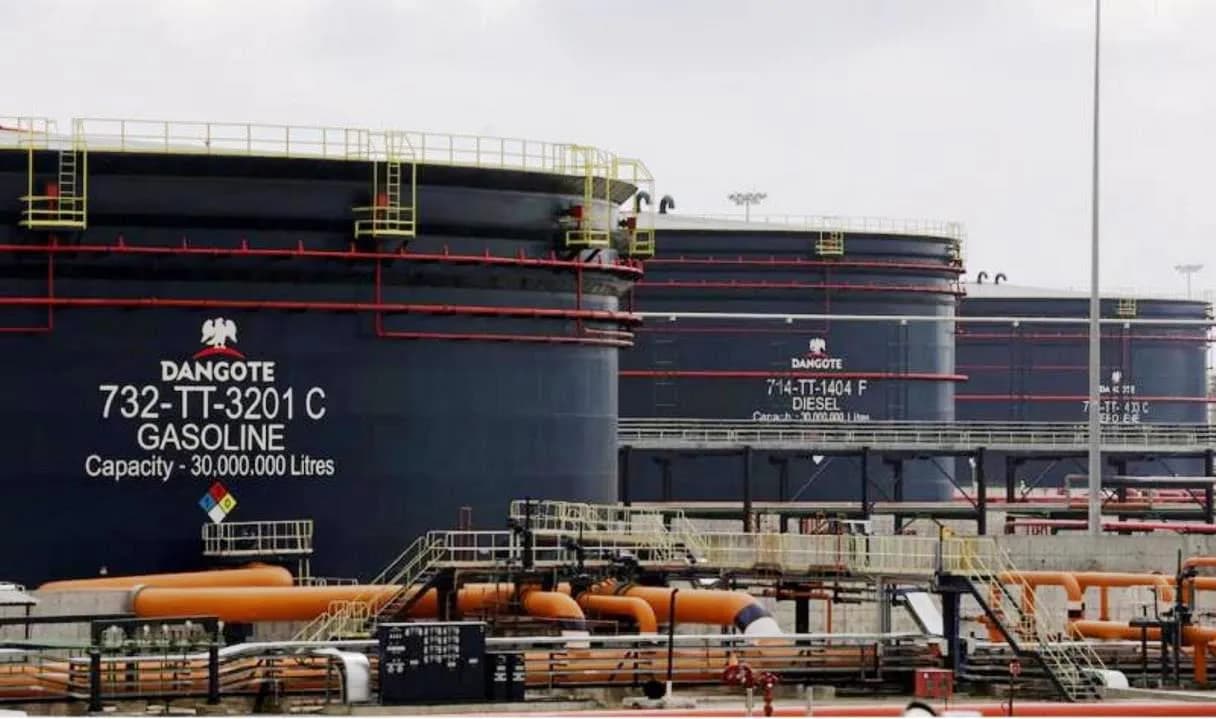
Nigeria’s downstream petroleum market is again under the spotlight as the Dangote Petroleum Refinery declared its ability to supply 120 million litres of refined petroleum products daily, a figure that places renewed focus on the long-running debate over domestic supply capacity, import dependence and regulatory control.
In a public notice, the refinery stated that it can supply 75 million litres of petrol (PMS), 25 million litres of diesel (AGO) and 20 million litres of jet fuel per day volumes that exceed Nigeria’s estimated daily consumption across all three products.
Supply Figures Reignite Regulator–Refinery Dispute
The declaration comes against the backdrop of an unresolved dispute between Dangote Refinery and the Nigerian Midstream and Downstream Petroleum Regulatory Authority (NMDPRA) over actual daily supply volumes and the continued issuance of import licences for refined products.
In November 2025, the NMDPRA reported that Dangote Refinery supplied about 19.5 million litres of PMS per day, compared with an estimated national consumption of 52.9 million litres, a position used to justify ongoing petrol imports. The refinery, however, countered this narrative in January 2026, stating that it was consistently supplying between 40 million and 50 million litres of petrol daily to the domestic market.
Aliko Dangote accused the former leadership of the NMDPRA of undermining local refining by approving imports beyond national requirements, describing the practice as detrimental to Nigeria’s energy security and domestic investment.
The regulator issued import approvals to ensure uninterrupted supply, stating that the refinery lacked full licensing at the time to independently meet total national demand.
Quality Claims, Imports and Legislative Intervention
The disagreement also extended to product quality. The NMDPRA had earlier questioned the consistency and standardisation of Dangote Refinery’s output, suggesting it fell below imported product benchmarks. In response, the refinery invited the House of Representatives to oversee independent testing, which showed that Dangote’s diesel contained significantly lower sulphur levels than imported alternatives.
The escalating public exchanges prompted parliamentary intervention, with lawmakers directing all parties to halt media accusations and launching a formal inquiry into the allegations of sabotage, import licensing practices and regulatory oversight.
As of January 2026, the Independent Petroleum Marketers Association of Nigeria (IPMAN) has publicly backed Dangote Refinery, stating that its members are satisfied with locally supplied products and opposing continued large-scale imports.
Capacity Now Documented, Execution Still Key
With the refinery now stating its supply capacity, industry observers say the debate has moved from whether Nigeria can refine enough fuel to how efficiently operators evacuate, price and distribute the products.
While the Dangote Refinery reaffirmed its commitment to regulatory compliance and cooperation with authorities, analysts note that clarity around licensing, logistics and market coordination will determine whether the stated 120 million litres daily capacity translates into sustained market stability.
For Nigeria’s downstream sector, the figures intensify a critical question: if capacity exists locally, how long can imports remain structurally justified?