

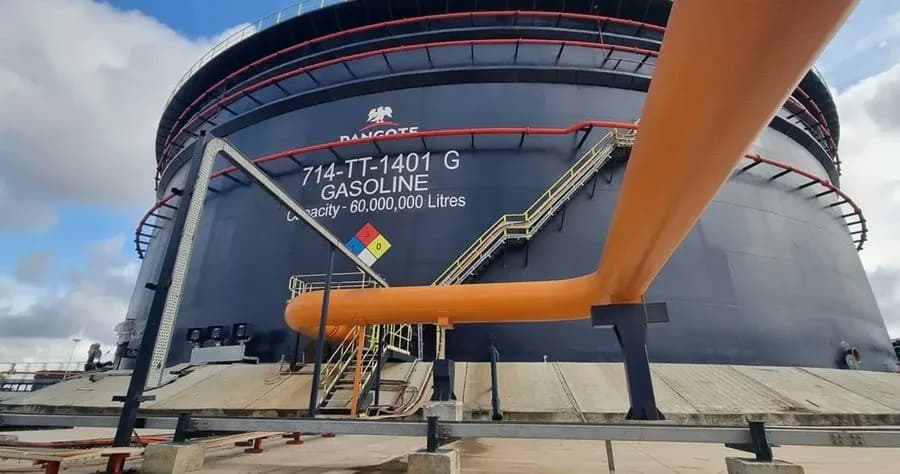
Nigeria’s petrol imports dropped to their lowest level on record in June, driven by rising domestic output from the 650,000 barrels-per-day Dangote Petroleum Refinery, new tracking data has revealed.
According to a report by Argus, citing figures from Kpler, the surge in local refining has sharply reduced Nigeria’s need for petrol from traditional suppliers in Europe, including the United Kingdom and Norway. Shipments from Europe to Nigeria fell by 56 per cent month-on-month in June to 231,000 metric tonnes—the lowest level recorded by Kpler since it began monitoring such flows.
When combined with volumes from offshore Lomé (28,000 mt) and Houston (12,000 mt), total imports into Nigeria stood at 271,000 metric tonnes, or roughly 363 million litres of petrol.
This development positions the country closer to achieving a major policy goal: reversing its decades-long dependence on imported fuel. Nigeria, once West Africa’s largest gasoline importer, even slipped behind Togo in import volume last month, as Dangote ramped up domestic supply.
Dangote Exports Surpass Expectations
At the same time, the refinery exported a record 252,000 metric tonnes of petrol in June, with shipments sent to Oman, Malaysia, and the Ivory Coast, reflecting growing global confidence in Dangote’s product quality and logistics.
These included:
- 90,000 mt to Sohar, Oman aboard the Pis Kerinci
- 89,000 mt to Pasir Gudang, Malaysia on the Hafnia Larissa
- 35,000 mt to Abidjan via the Sabaek
- An additional 39,000 mt was also carried by the Sabaek, yet to be discharged
According to Dangote Group Executive Director Edwin Devakumar, the refinery has the flexibility to ramp up further production by leveraging its naphtha hydrotreating unit, and it has begun buying naphtha to expand gasoline yields.
Domestic Crude Usage Rising, Full Transition Expected
In a related development, Devakumar confirmed to Bloomberg that the facility expects to rely entirely on Nigerian crude oil by the end of 2025, a shift that could displace hundreds of thousands of barrels of imported crude per day.
In June, Dangote sourced 53 per cent of its crude from domestic producers and 47 per cent from the U.S., but this ratio is expected to tilt fully local as long-term contracts with foreign suppliers expire. The refinery is currently processing about 550,000 barrels per day, with plans to lift five Nigerian cargoes in both July and August, each holding nearly one million barrels.
Between January and April 2025, the Nigerian government sold N219.38 billion worth of crude to Dangote, based on FAAC documents, amounting to over 1.9 million barrels across nine cargoes. These were sourced from the Okwuibome field operated by Sterling Oil and Nigerian Agip Exploration. However, in May, FAAC records showed that the refinery received no new cargoes.
European Traders Face New Reality
The sharp fall in Nigerian petrol imports has rattled European traders. A source told Argus that weaker Nigerian demand—combined with lacklustre U.S. gasoline consumption—has created uncertainty over outlet options for European supplies this summer.
Petrol cracks, which measure refining margins, have remained steady. Between July 1 and 4, non-oxy gasoline barge cracks to ICE Brent averaged $14.73 per barrel, up slightly from $14.62 in the same period in 2024.
Dangote Cuts Ex-Depot Price to ₦820
Meanwhile, the Dangote Refinery has reduced its ex-depot petrol price to ₦820 per litre, down from ₦840. The ₦20 cut represents a 2.15% decline and marks the lowest rate since March 14, when petrol briefly sold for ₦815.
Marketers in Lagos and Warri confirmed the adjustment, which took effect immediately. This marks the refinery’s eleventh price revision of the year so far.
As the refinery continues to scale operations and displace imports, Nigeria appears to be entering a new era in domestic fuel supply, one where global markets must now adjust to the country’s shifting trade balance.