

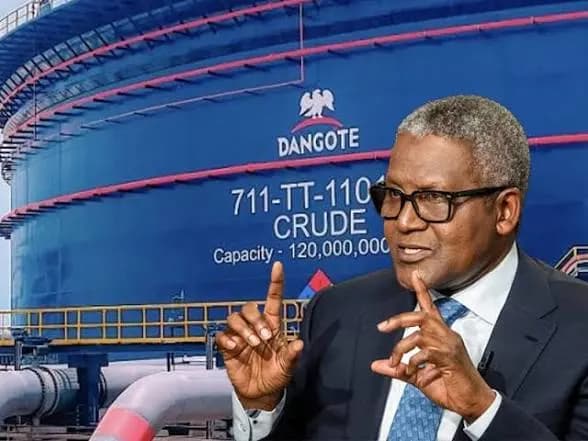
President of the Dangote Group, Aliko Dangote, has revealed that the Dangote Petroleum Refinery now receives about 56 per cent of its crude oil supply from the Nigerian National Petroleum Company Limited, marking a significant shift in Nigeria’s domestic crude supply structure as the refinery scales up production and reduces reliance on foreign feedstock.
Dangote made the disclosure during an interview on the In Good Company podcast hosted by Nicolai Tangen, where he explained that the remaining crude requirements are sourced from countries including Angola, Libya and the United States to sustain operations at the 650,000 barrels-per-day refinery in Lagos.
According to him, the refinery currently consumes about 21 crude cargoes monthly to sustain refining operations, underlining the scale of production at the 650,000 barrels-per-day plant.
“We source about 56 per cent from Nigeria and some from Angola. We buy quite a bit from Angola, we buy from Libya, and we buy from the US. At one point, we were doing about seven to eight cargoes of WTI from the US. But we’re getting more of Nigeria’s crude now,” Dangote said during the interview.
“We have to now buy 21 cargoes every month. That’s how big we are,” he added.
The disclosure points to a gradual increase in crude supply allocation from the NNPCL to domestic refining, a development industry operators say could further reduce Nigeria’s dependence on imported petroleum products and lower pressure on foreign exchange demand.
The refinery has emerged as Nigeria’s largest supplier of Premium Motor Spirit, diesel and aviation fuel, while also exporting refined products into regional and international markets.
Energy analysts say improved crude supply from the NNPCL could strengthen local refining stability and support the Federal Government’s drive to deepen domestic refining capacity.
Dangote also revealed during the interview that the refinery has processed crude above its installed nameplate capacity, reaching about 661,000 barrels per day during recent operations.
“The refinery has been tested. We have now processed even crude at 661,000 barrels a day. So we have demonstrated that capability,” he stated.
He further disclosed that the group plans to expand refining capacity to about 1.4 million barrels per day within the next 30 months, a move expected to significantly reshape fuel supply dynamics across Africa and reduce dependence on imported refined petroleum products.