

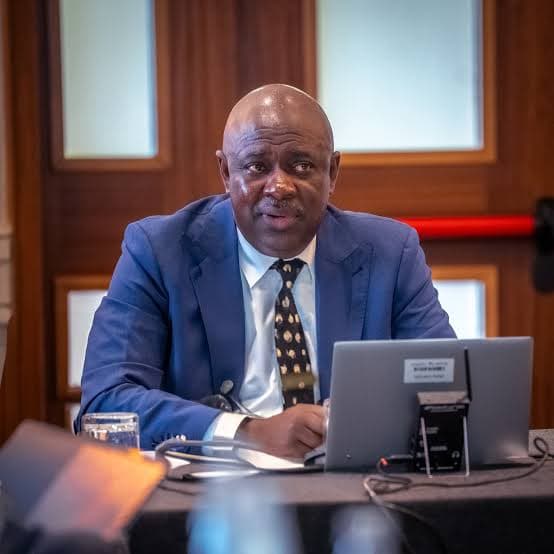
The Federal Government’s deregulation of Nigeria’s downstream petroleum sector has created the market conditions that enabled Dangote Petroleum Refinery to emerge as a major private-sector player and attract investors through its ongoing ₦2.15tn initial public offering, Minister of State for Petroleum Resources (Oil), Heineken Lokpobiri, has said.
Lokpobiri made the assertion on Thursday at the National Summit of the Forum of Former Presiding Officers of State Houses of Assembly of Nigeria in Abuja, where he linked the refinery’s growing role in the downstream market to the government’s decision to end the previous structure dominated by state-led fuel imports.
The Dangote Refinery IPO, which opened on September 14, involves 4.1 billion ordinary shares priced at ₦525 each, with the offer targeting approximately ₦2.15tn. The public offer is scheduled to close on October 13, with a minimum subscription of 10 shares, valued at ₦5,250.
Lokpobiri said deregulation had fundamentally changed the operating environment for petroleum refining and product supply, allowing private capital to play a larger role in an industry previously heavily dependent on imported refined products.
“I want to take the opportunity to say today that the reason why Dangote’s IPO, which is the largest in the African continent, is successful today is because of deregulation.
“Before now, NNPCL used to be the sole importer of refined products. We export our crude and we import refined products. Today, NNPCL doesn’t import any refined products because NNPCL is also a shareholder of Dangote Refinery.
“We invested strategically in Dangote Refinery; we are a shareholder in Dangote Refinery.”
The minister also confirmed the Federal Government’s support for the offer and expressed confidence that demand for the shares would exceed the amount being offered.
“The IPO that is going on is absolutely supported by this government, and we believe that it will be oversubscribed,” he said.
For the downstream industry, the significance of the IPO extends beyond the capital being raised. The offer places a major privately owned refinery within Nigeria’s public equity market while the country continues its transition from an import-dependent petroleum products market towards greater domestic refining and supply.
Lokpobiri also attributed the absence of the widespread petrol queues that previously characterised periods of supply disruption to the reforms implemented since 2023.
“It’s important for us to know that all these successes are the result of Mr President’s bold decision to completely deregulate the petroleum sector.
“I’m happy my colleague from Adamawa had said here that we had a perennial problem in this country. Every time, we used to have queues, particularly during the festive season.
“But since 2023, we haven’t experienced any queues in this country till today. And by the grace of God, we are not going to have such queues.”
The minister further said petroleum-sector reforms were strengthening Nigeria’s foreign-exchange position, claiming that the sector contributes about 85 per cent of the country’s forex earnings. He put the country’s foreign reserves at about $54bn, while the latest available figure cited in the report stood at $54.61bn as of September 14, 2026.
He also said the Federal Government had cleared almost $7bn in outstanding foreign-exchange obligations owed to international airlines, arguing that the settlement helped restore confidence in Nigeria’s aviation and foreign-exchange environment.
“Don’t also forget that before Mr President came, the airlines in Nigeria couldn’t repatriate their returns, and so airlines like Emirates and some other airlines even suspended operations.
“The debt then was almost $7bn. That was cleared. If that debt wasn’t there, and that $7bn was added to the $54bn, today our forex, I mean, our foreign reserves, would have been over $60bn,” he said.
Lokpobiri’s comments come as Dangote Refinery continues to occupy a central position in Nigeria’s downstream market, with its domestic refining capacity changing the supply structure for petrol and other refined products and increasing the role of locally produced fuels in the market.
The minister urged former presiding officers of state Houses of Assembly to take the Federal Government’s reform message to their respective states, saying the administration’s policies needed to be sustained.