

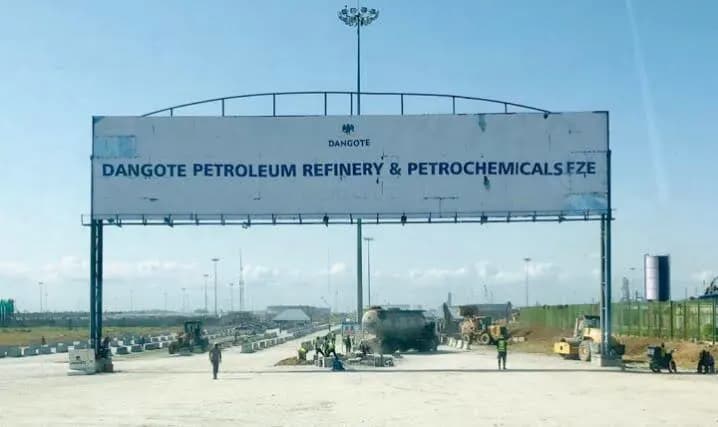
Fresh market developments indicate that the Dangote Petroleum Refinery and Petrochemicals is witnessing a decline in truck loading activity, as marketers increasingly shift to private depots offering relatively lower fuel prices.
Checks by Petroleumprice.ng on Thursday show that several private depots across key locations are currently undercutting Dangote’s gantry price for Premium Motor Spirit (PMS), creating a pricing disparity that is reshaping loading patterns.
In Lagos, PMS prices at private depots were observed at ₦1,250 per litre, with operators such as Wosbab, Ascon, Bovas, Bono, and Sahara maintaining similar levels. In Port Harcourt, Masters depot was selling slightly lower at ₦1,240 per litre.
By contrast, Dangote refinery’s gantry price remains higher at around ₦1,275 per litre, widening the gap between refinery and depot pricing.
Industry sources attribute the shift to a series of sustained price increases by the refinery over the past month. PMS prices have climbed from ₦799 to ₦1,275 per litre, representing an increase of approximately 59.6 per cent. Similarly, Automotive Gas Oil (AGO) rose from ₦880 to ₦1,750 per litre, marking a surge of about 98.9 per cent.
The consistent upward adjustments have pressured marketers’ margins and slowed offtake at the refinery’s gantry. Under the existing supply arrangement with about 20 approved marketers, 75 per cent of allocated volumes are lifted via marine (coastal) supply, while 25 per cent is designated for gantry loading.
However, marketers say the pricing structure has created inefficiencies. In several cases, depot owners who lift products from Dangote are reselling at their own facilities at prices lower than the refinery’s gantry rate, effectively drawing demand away from direct loading.
For instance, Nipco is pricing PMS around ₦1,260 at their private depots, while the same product sourced from Dangote’s gantry was priced higher at about ₦1,282, highlighting a structural mismatch in the distribution chain.
This pricing gap has triggered a surge in activity at private depots, particularly in Lagos, where truck traffic has intensified. Field observations indicate that more depot operators are now lifting bulk volumes from the refinery and redistributing through their own storage facilities, where pricing flexibility allows them to compete more aggressively.
Market participants warn that unless pricing realigns with prevailing crude oil trends and depot realities, the shift in demand could persist. Many marketers are already indicating a preference to route purchases through private depots rather than load directly from the refinery.
The development underscores growing tension within Nigeria’s downstream fuel market, where pricing dynamics between the dominant local refiner and independent depot operators are increasingly influencing supply routes, margins, and retail outcomes.