

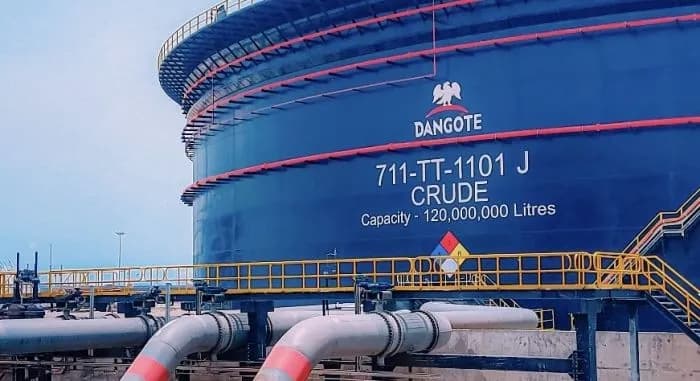
The Nigerian downstream petroleum sector is witnessing fresh tension as marketers exploiting supplies from Dangote Refinery cash in on abnormal profits, sparking a growing price war with private depots across the country. What was meant to be a major breakthrough in stabilising fuel prices is now fuelling controversy, exposing the fault lines in Nigeria’s fragile supply chain.
Marketers’ Profit Game at Dangote Refinery
Dangote Refinery, Africa’s largest single-train refinery, currently sells Premium Motor Spirit (PMS) at ₦846 per litre. In theory, this should ease the pressure of volatile imports and gradually lower pump prices. But in practice, some marketers have turned the opportunity into a profit-making scheme.
Rather than passing the savings to consumers, they purchase with a proforma invoice at ₦820 and resell at ₦846 or higher. By doing so, they pocket huge amounts; analysts say it exceeds the 4 percent mark. In real terms, that is about ₦30 extra on every litre — a staggering windfall once multiplied by the millions of litres traded daily.
As one downstream expert put it: “If a marketer buys two million litres and slaps on ₦30 per litre, that’s about ₦6 million in revenue in just one cycle. Some marketers can offload that volume within hours. It’s a huge cash-out.”
Depot Prices Across Nigeria
The knock-on effect is visible across depots, where private operators are struggling to maintain parity with Dangote-linked marketers. Midday price tracking on Friday showed:
Lagos Depots (PMS per litre)
- MENJ – ₦842
- EMADEB – ₦845
- AIPEC – ₦845
- INTEGRATED – ₦845
- AITEO – ₦844
Warri Depots
- Matrix – ₦860
- AYM Shafa – ₦860
Calabar Depots
- Evergreen – ₦860
- Matrix – ₦860
Port Harcourt Depots
- Bulk Strategic – ₦860
- Liquid Bulk – ₦860
While some Lagos depots hover just below Dangote’s refinery price, depots outside the state are firmly pegged at ₦860 — signalling a widening gap that can distort supply and distribution patterns across regions.
Ticketing Bottlenecks and Supply Constraints
Industry insiders link this profit-taking behaviour to structural inefficiencies in Dangote Refinery’s release process. The tickets—essentially allocations that guarantee product lifting—are reportedly oversold compared to the actual available volume. This mismatch fuels artificial scarcity, allowing a handful of marketers to dictate prices.
In effect, what was meant to be a price moderation mechanism has mutated into a speculative playground, where opportunistic players are thriving at the expense of consumers and competing depots.
The Irony of Dangote’s Vision
When Aliko Dangote unveiled his refinery, the central promise was clear: Nigeria would finally cut its dependence on imported petrol and achieve cost relief at the pump. Instead, the refinery’s limited output and speculative trading by middlemen have temporarily undermined that vision.
Private depots now find themselves squeezed — forced to either match the inflated prices or risk being sidelined in a market that increasingly bends to those with refinery access.
What This Means for the Downstream Sector
The unfolding scenario underscores the fragility of Nigeria’s downstream sector, where structural inefficiencies often give room for profiteering. Unless the refinery recalibrates its distribution process ensuring ticket allocations match product releases the price war could deepen.
Analysts argue that reforms around supply transparency, pricing discipline, and regulatory oversight will be crucial if the Dangote Refinery is to live up to its promise of stabilising the fuel market. Otherwise, the refinery may inadvertently entrench the very problem it was designed to solve: artificial scarcity and inflated margins.