

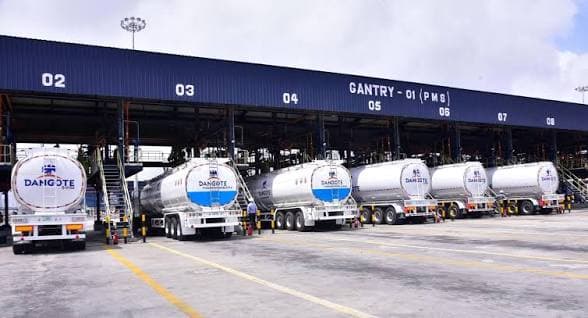
Dangote Refinery consortium marketers have reduced its petrol gantry price from ₦1,265 to ₦1,210 per litre as at the time of writing, a cut of ₦55 or 4.35 per cent in a single day, intensifying competition across Nigeria’s downstream petroleum market and forcing depot operators to review their prices.
The reduction comes as the European gasoline benchmark, EBOB, used in the refinery’s restructured pricing arrangement has been declining, giving marketers greater room to adjust their selling prices. Industry sources indicate that strong product availability and narrowing margins are adding to the competitive pressure.
Petroleumprice.ng gathered that several Lagos depots closed on Thursday at an average price of about ₦1,300 per litre. By Friday, October 30, prices had fallen sharply following Dangote-linked price adjustments, with some depots cutting as much as ₦40 per litre, equivalent to 3.08 per cent against the Thursday closing level.
Friday’s reported Lagos depot prices showed African Terminal, Integrated, Rainoil, Ardova and Nipco quoting ₦1,260 per litre, while Aiteo offered the lowest price at ₦1,255 per litre. Across the six quoted price entries, the average stood at ₦1,259.17 per litre, representing a decline of ₦40.83, or 3.14 per cent, from Thursday’s average closing price of ₦1,300 per litre.
The price adjustments underline the growing influence of Dangote Refinery’s pricing decisions on the wider wholesale market. With the refinery lowering its gantry price and consortium marketers competing for sales, independent depot operators are under pressure to reduce their offers to remain attractive to buyers.
The latest movement also points to a market in which product availability and benchmark-linked pricing are shaping competition. However, the extent to which further reductions are possible will depend on changes in the EBOB benchmark, supply conditions, marketers’ purchase costs and operating margins.
For marketers and bulk buyers, the immediate impact is a lower wholesale price environment. Whether the reductions will translate into sustained savings at retail outlets will depend on subsequent depot prices, distribution costs and the pace at which retailers adjust pump prices.