

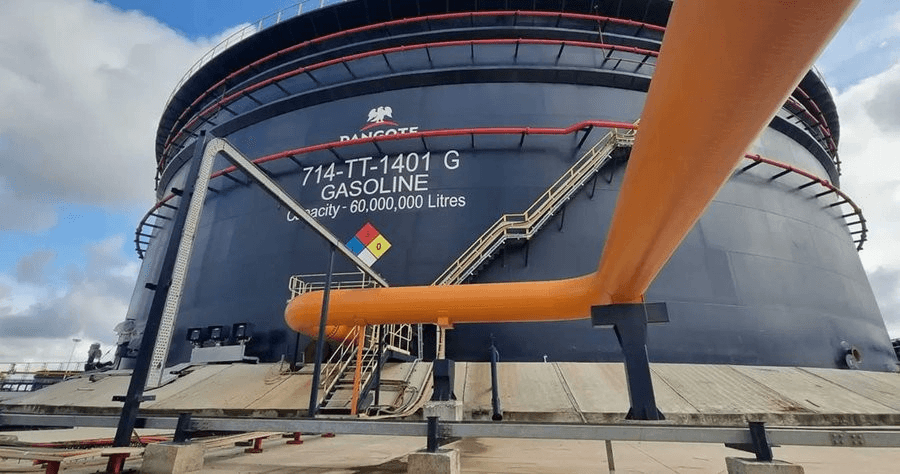
Dangote Petroleum Refinery produced an average of 84.43 million litres of petrol, diesel, and aviation fuel daily in August 2026, according to data from the Nigerian Midstream and Downstream Petroleum Regulatory Authority (NMDPRA).
The refinery operated at an average of 105.21 percent of its stated capacity during the month. Its daily output included 41.94 million litres of petrol, 18.01 million litres of diesel and 24.48 million litres of aviation fuel.
Petrol accounted for the largest share of the refinery’s output and supplied a significant portion of the product delivered into the Nigerian market during the month.
Dangote Refinery recorded average domestic receipts of 35.87 million litres of petrol per day in August, while 9.73 million litres per day were exported.
For diesel, the refinery supplied an average of 12.37 million litres per day to the domestic market and exported 8.75 million litres. Aviation fuel had a stronger export component, with 21.30 million litres exported daily compared with 3.07 million litres supplied domestically.
The refinery ended August with 360.4 million litres of petrol in stock, alongside 137.2 million litres of diesel and 133.3 million litres of aviation fuel. Combined stocks of the three products stood at 630.9 million litres.
The refinery’s strong performance came as crude oil supplies to Nigeria’s domestic refineries increased during the month.
According to NMDPRA, average crude receipts rose by 17 percent from 585,000 barrels per day in July to 683,000 barrels per day in August.
Between January and August, domestic refineries received 137.98 million barrels of crude. About 79.64 percent came from domestic sources, while the remaining 20.36 percent was supplied through imported seaborne crude cargoes.
August recorded the highest monthly crude receipt during the period, at 21.10 million barrels.
NMDPRA also reported that Dangote Refinery received a cumulative 1.86 billion litres of gasoline blendstock between January and August. The highest monthly volume was recorded in January at 658.31 million litres, while no blendstock receipt was recorded in July.
The refinery’s petrol production also coincided with a significant change in Nigeria’s petrol supply pattern.
Total petrol supplied into the Nigerian market increased by 11 percent from an average of 45.5 million litres per day in July to 50.5 million litres in August. Domestic supply rose by 39 percent from 25.8 million litres to 35.9 million litres per day, while imports fell by 26 percent from 19.7 million litres to 14.6 million litres per day.
Dangote Refinery’s reported domestic petrol receipts of 35.87 million litres per day were almost equal to the total domestic petrol receipts recorded nationally in August.
The increase in domestic supply came despite lower petrol consumption during the month. NMDPRA put average petrol consumption at 41.5 million litres per day in August, down from 48.3 million litres in July.
August therefore recorded the lowest petrol consumption in the 13-month period covered by the regulator’s data. The 13-month average stood at 51.1 million litres per day, while the highest monthly consumption was 63.7 million litres per day in December 2025.
Despite the increase in domestic petrol supply, national petrol stock levels remained below the regulator’s 30-day benchmark. NMDPRA reported 22.9 days of petrol stock sufficiency at the end of August, slightly higher than the 22.4 days recorded in July.
Diesel and aviation fuel had stronger stock positions, with national stock sufficiency of 51.6 days and 82.3 days respectively.
Dangote’s August performance also came as several other major Nigerian refineries remained inactive. NMDPRA listed the Port Harcourt, Warri and Kaduna refineries as not producing during the month.
Among operating modular refineries, Edo Refinery recorded the highest capacity utilisation at 90.43 percent, followed by WalterSmith at 64.77 percent and Aradel at 58.77 percent. OPAC recorded 16.97 percent, while Duport Refinery was listed as shut down.
The August figures show Dangote Refinery serving both the Nigerian and international markets, with petrol making up the largest share of its reported output and aviation fuel accounting for the largest share of its exports.
The refinery’s performance also coincided with a rise in locally supplied petrol and a decline in imports during the month, as domestic refineries supplied a larger share of the petrol entering the Nigerian market.