

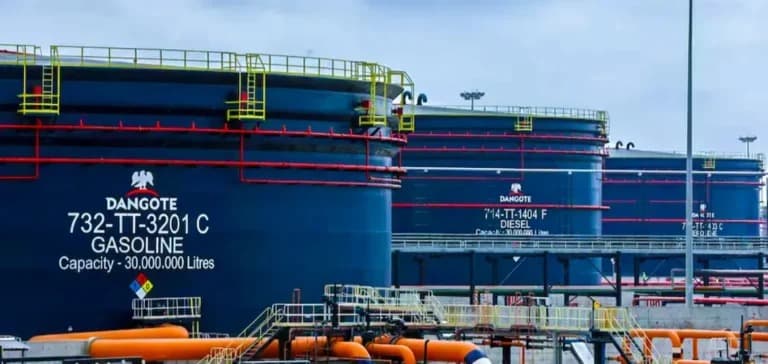
Dangote Petroleum Refinery's offshore marine terminal has recorded approximately 1,100 tanker calls since commencing operations, marking another major milestone for the 650,000 barrels-per-day facility as it continues to expand crude oil imports and refined petroleum exports across domestic and international markets.
The refinery also disclosed that it is currently handling an average of 75 tanker calls every month, with vessel traffic projected to increase to between 900 and 1,000 calls annually as the refinery reaches full operational capacity. The figures underscore the growing scale of marine logistics supporting what is now Africa's largest single-train refinery.
The Head of Port Infrastructure and Marine Operations at Dangote Petroleum Refinery and Petrochemicals, Captain Satendra Singh Rana, disclosed the figures during a guided tour of the refinery's marine facilities for participants of the Global CEO Africa Programme organised by the Lagos Business School. The delegation also toured the refinery's gantry, processing units, laboratory, main control room, crude storage tanks and other key operational facilities.
Speaking at the refinery's Landfall Point, also known as the Trestle, Rana explained that the facility serves as the critical connection between the refinery and its offshore marine infrastructure. According to him, the increasing number of tanker movements reflects the refinery's growing contribution to Nigeria's energy industry and maritime economy.
"We are now clocking about 75 tanker calls a month. We are looking to scale to 900 to 1000 tanker calls per year as the refinery is ramped up to full capacity already."
"Today we have clocked approximately 1100 tanker calls already, changing the energy landscape and maritime economy, bringing Nigeria to the forefront, not only by the refinery but for the maritime trade as well," Captain Rana stated.
Rana explained that crude oil delivered by large ocean-going tankers is discharged through the refinery's offshore Single Point Mooring (SPM) terminals before travelling via subsea pipelines into crude storage tanks, where it undergoes distillation and secondary refining processes. Once refined, finished petroleum products are pumped through separate pipeline systems back to the offshore terminals for export or domestic distribution.
According to him, the refinery operates five offshore Single Point Mooring terminals, comprising two dedicated to crude oil imports and three used for loading refined petroleum products, enabling crude imports and product exports to take place simultaneously. The arrangement, he said, has significantly improved operational efficiency while supporting the refinery's growing production volumes.
Rana further disclosed that the offshore loading system was deliberately designed to accommodate Very Large Crude Carriers (VLCCs), which require natural water depths of about 21 to 22 metres. He noted that the system eliminates the need for costly capital and maintenance dredging associated with conventional ports while allowing the refinery to receive some of the world's largest crude oil tankers.
He revealed that one of the largest vessels handled by the terminal delivered three million barrels of crude oil, while VLCCs carrying approximately two million barrels now call at the refinery regularly. The facility also receives frequent one-million-barrel cargoes aboard Suezmax tankers sourced from both domestic and international producers.
Rana added that the refinery's offshore location offers additional operational advantages because it is not exposed to cyclones, typhoons and other severe weather systems that often disrupt marine operations elsewhere. According to him, vessels berth directly at the refinery's Single Point Mooring terminals, where floating hoses connect them to pipelines anchored beneath the seabed, eliminating the need for ship-to-ship (STS) transfers that are commonly used in offshore crude handling.
The Academic Director of the Global CEO Africa Programme at Lagos Business School, Pan-Atlantic University, Enase Akinwuntan, described the Dangote Refinery as one of Africa's most significant industrial projects, stating that it demonstrates the continent's ability to deliver large-scale investments capable of transforming regional economies.
"Led by Alhaji Aliko Dangote and funded with local resources, the refinery symbolizes a bold commitment to advancing Africa's industrial capabilities," he said.
Akinwuntan noted that the refinery's impact extends beyond Nigeria's downstream petroleum industry, arguing that domestic refining and the export of refined petroleum products provide a practical example of value addition that can strengthen regional trade under the African Continental Free Trade Area (AfCFTA). He added that exposing executives participating in the Global CEO Africa Programme to projects of such scale provides valuable lessons in executing transformational investments capable of building globally competitive African businesses.
The latest operational milestone comes as Dangote Petroleum Refinery continues to strengthen its financial position ahead of its planned Initial Public Offering (IPO) later this year. The company recently raised $2.5 billion through a private placement to support further expansion, deepen production capacity and increase exports, reinforcing its ambition to position Nigeria as a major refining and petroleum export hub for Africa and the global energy market.