

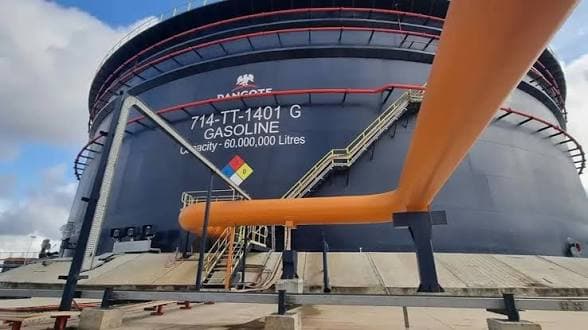
Dangote Petroleum Refinery and Petrochemicals generated ₦19.47 trillion in revenue and ₦2.55 trillion in profit after tax in the first half of 2026, marking a sharp turnaround as the 650,000-barrel-per-day facility significantly increased its operating capacity.
The figures contained in the refinery’s IPO prospectus show that the company recorded $1.82 billion in profit after tax and $13.91 billion in revenue in the six months to June 2026, using an exchange rate of ₦1,400 to the dollar cited by THISDAY.
The result represents a major reversal from the $476 million loss recorded for the full year 2025, according to the prospectus, from which Reuters and Billionaires Africa first extracted the financial performance.
A major driver of the turnaround was higher refinery utilisation. Average utilisation climbed to 83.6 per cent during the first half, after the plant began the year at about 45 per cent.
The facility subsequently reached full crude distillation unit utilisation during the second quarter after improvements to its residual fluid catalytic cracker and a shift away from lower-value reduced crude oil production.
Its earnings before interest, tax, depreciation and amortisation also reached $2.60 billion, equivalent to about ₦3.64 trillion, while EBITDA margin stood at 18.7 per cent.
The refinery’s gross refining margin strengthened alongside the higher throughput, reaching $24.50 per barrel in the first half of 2026, compared with $13.70 per barrel in 2025 and $10.70 per barrel in 2024.
The stronger financial position comes as Dangote Refinery prepares to raise about ₦2.26 trillion through its planned initial public offering. The approved offer comprises 4.1 billion ordinary shares at ₦525 each, with the company positioning the transaction as a “people’s IPO” intended to broaden ownership among Nigerians, members of the diaspora and other Africans.
Dangote Refinery is also planning a major expansion that would increase its processing capacity to 1.4 million barrels per day by 2029.
The expansion is estimated at $14.3 billion, or about ₦20.02 trillion at the ₦1,400-per-dollar exchange rate used in the prospectus. The project is expected to add petrochemical and refining units, expand the range of products manufactured at the facility and strengthen its ability to replace imports.
Chief Executive Officer David Bird told Reuters that the refinery's improved performance had changed the funding outlook for the expansion programme.
“We’re at full capacity, 700,000 barrels per day; we are enjoying those upswings, and yes it has fundamentally changed the funding premise of this Vision 2030,” Bird said.
According to Bird, the expanded facility will also be capable of producing different diesel specifications while additional petrochemical capacity will support import substitution.
The refinery has increasingly expanded its presence in international markets since beginning commercial operations in 2024. It has exported refined products including diesel and jet fuel, and exported jet fuel to the United States for the first time this year.
S&P Global Energy also identified the facility as the world's largest single exporter of jet fuel during April and May.
The company's stronger performance has coincided with widespread disruptions to global refining capacity caused by geopolitical conflicts.
Bird said fuel shortages could persist even after the US-Iran conflict ends because damaged refineries would require repairs while inventories would also have to be rebuilt.
“We went in (to the Iran war) at high refinery utilisation (rates), and there’s been deferred maintenance and damage to Middle East refineries – that’s just to meet current demand. Plus inventories have to be rebuilt, plus a lot of countries are talking about supply security and increasing stocks,” he said.
The global supply disruption has also benefited refiners with available capacity, as damage to facilities in the Middle East and disruptions to Russian exports have tightened international supplies of gasoline and diesel.
The latest escalation in the Middle East has added another layer of uncertainty to the energy market.
Yemen's Iran-backed Houthis attacked four cities in southern Saudi Arabia, striking a Saudi airbase in Khamis Mushait and assets belonging to Saudi Aramco in Abha, Najran and Jazan with drones and missiles.
Saudi authorities said the attacks caused fires at oil installations and injured 73 people, including women and children. The Houthis said the operation represented a broader assault on Saudi territory.
The renewed fighting has also pushed crude prices higher. Brent crude touched $99.46 per barrel on Tuesday, its highest level since July 24, while US West Texas Intermediate reached its strongest level since June 8 before both benchmarks later eased.
The attacks raise concerns that disruptions could extend beyond the Strait of Hormuz and affect other Middle Eastern energy supply routes, particularly as Houthi activity has previously threatened shipping around the Red Sea.
Saudi Arabia has led an Arab coalition against the Houthis for more than a decade. While fighting had eased in recent years, the ceasefire has broken down as Saudi-backed Yemeni government forces launch a new offensive against Houthi-held territory.
For Dangote Refinery, the combination of higher utilisation, stronger refining margins and international supply disruptions has created a markedly different operating environment from 2025, when the facility posted a full-year loss.
Aliko Dangote said at the IPO signing ceremony in Lagos that although the refinery had benefited from supply disruptions caused by conflicts in the Middle East and Ukraine, its investment was designed for long-term sustainability.
The refinery was built at an estimated cost of $20 billion and began operations in 2024. Its planned expansion to 1.4 million barrels per day would place it among the world's largest refining complexes and significantly increase its capacity to serve both Nigerian and international markets.