

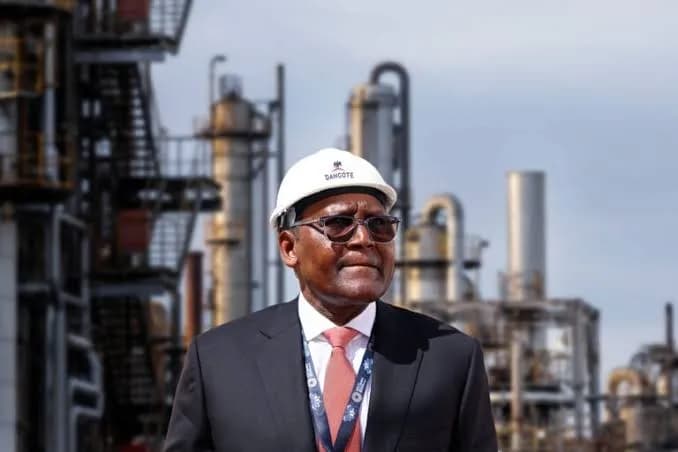
Africa’s largest oil refining facility is undergoing a strategic upgrade as the Dangote Petroleum Refinery moves to increase its processing capacity from 650,000 to 700,000 barrels per day (bpd), according to the President of the Dangote Group, Alhaji Aliko Dangote.
Speaking during a recent facility tour in Lekki, Lagos, Dangote disclosed that modifications are currently in progress and are expected to conclude by the fourth quarter of 2025. The aim is to unlock an additional 50,000 bpd, positioning the refinery well beyond its original design capacity.
Modifications Drive Delayed Full-Scale Production
The upgrade, Dangote explained, has temporarily limited the refinery from operating at full tilt. “Our Residue Fluid Catalytic Cracking unit is currently at 85 per cent capacity,” he revealed. “We haven’t hit 100 per cent because of ongoing modifications. Once completed by year-end, we expect to exceed 650,000 bpd and reach 700,000 bpd.”
The RFCC is a critical component of refining operations, transforming heavy crude residues into high-value products such as petrol, diesel, and LPG. Dangote added that while this unit awaits completion, other departments are already outperforming expectations. “Some components are even running at 145 per cent. We’ve done very well in that area,” he said.
U.S. Becomes Key Supplier of Feedstock Crude
To sustain operations during the ramp-up phase, the refinery has leaned heavily on U.S. crude oil. Dangote revealed that the company purchased 19 million barrels of crude from the United States between June and July 2025 alone, with 10 million barrels acquired in early July.
“At our current production level, about 55 per cent of our crude supply this month has come from the U.S.,” he noted. This move underscores the refinery’s growing global footprint and diversification of supply chains.
Refinery Vision Born from Policy Setback
Dangote recounted that the multi-billion-dollar refinery project was inspired by a failed attempt to acquire Nigeria’s state-owned refineries in 2007 during the tenure of late President Umaru Yar’Adua. “That denial was the catalyst. It pushed us to build from scratch to ensure Nigeria and Africa can achieve energy self-sufficiency,” he said.
However, the journey was far from straightforward. “If I had known what we were getting into, I wouldn’t have started it. People assume building a refinery is like constructing a house—but it’s nothing like that,” Dangote admitted.
The project presented constant dilemmas due to its complexity. “There were moments we had to decide whether to stop and sink or continue and succeed. We chose to push forward,” he added.
Africa’s Refining Gap and External Pressures
Dangote emphasized the urgent need for local refining capacity in Africa, where the majority of countries still depend heavily on fuel imports. “Apart from Algeria and Libya, virtually every African country imports fuel,” he said.
He also criticised foreign commercial interests that profit from Africa’s dependence on imports. “If you visit Lome, you’ll see rows of ships. This is part of a deliberate strategy to stifle industrial growth in sub-Saharan Africa through relentless importation.”
In contrast, he praised his team’s resolve to defy global pressures and fill a critical infrastructure gap. “Even South Africa has only one functioning refinery today. We took the risk others wouldn’t,” Dangote said.
A Step Closer to African Energy Independence
Once fully operational at its upgraded capacity, the Dangote Refinery is poised to significantly alter the continent’s fuel dynamics by reducing its dependency on imports and stabilizing local supply chains.
Despite facing what he described as “one of the most complex industrial challenges in Africa,” Dangote remains confident that his $20 billion investment will redefine Nigeria’s role in the global energy market.