

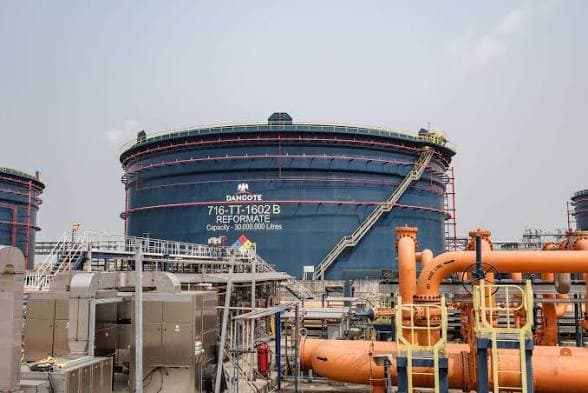
Dangote Petroleum Refinery exported an average of 54.63 million litres of petrol, diesel and aviation fuel per day in September 2026, exceeding its domestic deliveries by 14.65 million litres daily, according to data from the Nigerian Midstream and Downstream Petroleum Regulatory Authority (NMDPRA).
The figures mark a reversal from August, when the refinery supplied 51.31 million litres daily to the Nigerian market and exported 39.78 million litres. In September, domestic receipts fell to 39.98 million litres per day, while exports rose by 37.33 percent.
The shift occurred as the refinery operated at 105.98 percent of its installed capacity, its highest utilisation rate in the January–September period. Its combined production of Premium Motor Spirit (PMS), Automotive Gas Oil (AGO) and aviation turbine kerosene increased by 15.68 percent to 97.67 million litres daily, from 84.43 million litres in August.
A review of the NMDPRA’s September 2026 fact sheet showed that petrol exports rose by 58.99 percent to 15.47 million litres per day, while domestic receipts declined by 20.55 percent to 28.50 million litres.
Petrol production increased by 12.59 percent to 47.22 million litres daily from 41.94 million litres in August. The refinery exported part of this output and added about 3.25 million litres to its stocks.
Nigeria’s average daily petrol consumption was 44.4 million litres in September, meaning the refinery’s production exceeded estimated national consumption. However, its domestic deliveries met about 65 percent of the country’s petrol demand.
Diesel exports recorded an even sharper increase, rising by 81.83 percent to 15.91 million litres daily from 8.75 million litres in August. Domestic diesel receipts fell by 34.20 percent to 8.14 million litres per day, while production rose by 35.04 percent to 24.32 million litres.
As a result, the refinery exported nearly twice as much diesel as it supplied to the local market during the month.
Aviation fuel also contributed significantly to the export balance. Shipments increased by 9.15 percent to 23.25 million litres daily from 21.30 million litres in August, while domestic receipts edged up to 3.34 million litres from 3.07 million litres.
Exports accounted for 87.44 percent of the refinery’s aviation fuel evacuation in September, the highest export share among the three products.
Despite the overall export lead, domestic receipts of petrol and diesel combined remained higher than their exports. The refinery supplied 36.64 million litres of the two products daily to the local market, compared with exports of 31.38 million litres. The difference narrowed to 5.26 million litres per day from 29.76 million litres in August.
The refinery’s September utilisation rate followed a recovery from maintenance-related disruption in July, when operations fell to 71.09 percent after work on its crude distillation and residue fluid catalytic cracking units.
Utilisation had reached 101.25 percent in May and 101.36 percent in June, before recovering to 105.21 percent in August and 105.98 percent in September. The refinery recorded 99.12 percent in April, after operating at 61.27 percent in January, 78.13 percent in February and about 93.62 percent in March.
The September rate implied crude processing of approximately 689,000 barrels per day, above the 650,000 b/d installed capacity cited in the regulator’s data. The refinery’s management has said its capacity has since been upgraded to 700,000 b/d.
NMDPRA data showed that the refinery received about 618,000 barrels of crude daily in September. The difference between crude receipts and implied processing was approximately 71,000 b/d, which the report said was sourced from existing refinery inventories.
The export increase came amid a decline in petroleum product receipts across Nigeria. Average daily petrol receipts from domestic refineries and imports fell by 23.37 percent to 38.7 million litres in September, from 50.5 million litres in August.
Petrol imports dropped by 30.14 percent to 10.2 million litres per day, which the regulator attributed to the exhaustion of approved import permit volumes.
Diesel receipts fell by 40 percent to 8.7 million litres daily, the lowest level in the 13 months covered by the factsheet. The figure was below average daily consumption of 14.5 million litres. NMDPRA attributed the decline to reduced imports and domestic evacuation amid high prices.
Petrol stock sufficiency stood at 23.9 days in September, below the regulator’s 30-day benchmark. Diesel stock sufficiency also declined, from 51.6 days in August to 49.7 days.
The data highlight the distinction between refinery output and the volume delivered to the domestic market. Exports, inventory movements and market pricing all affect how much production reaches Nigerian consumers.
Dangote’s 700,000-barrel-per-day refinery began producing petrol in September 2024 and was expected to reduce reliance on imported products, conserve foreign exchange and strengthen domestic supply. The September figures show that rising production can coincide with lower local receipts when a substantial share of output is exported.
The challenge for regulators and policymakers is to balance domestic supply and stock requirements with refiners’ participation in international markets.