

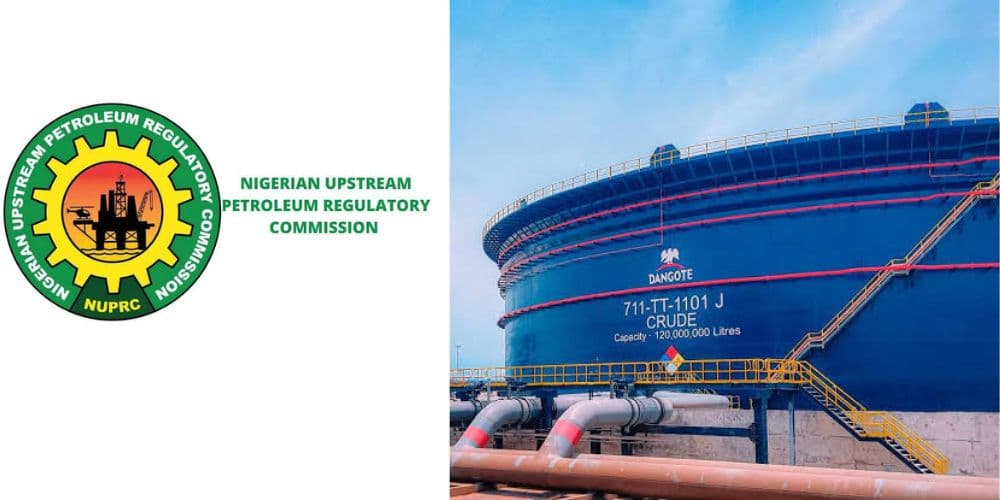
The Dangote Petroleum Refinery received about 98 percent of the crude oil and condensate actually supplied to Nigeria’s domestic refineries in the second quarter of 2026, highlighting the refinery’s dominant position in the country’s local crude supply market.
Data released by the Nigerian Upstream Petroleum Regulatory Commission (NUPRC) showed that domestic refiners received 53.7 million barrels during the quarter, with the Dangote refinery accounting for 52.6 million barrels.
The volume supplied to Dangote was, however, below the refinery’s stated requirement of 63 million barrels for the three-month period. Producers offered the facility 68.1 million barrels, meaning it ultimately took about 77 percent of the crude made available to it.
Across the domestic refining sector, producers offered 69.3 million barrels during the quarter against an allocation of 55.1 million barrels. Although the offers exceeded the allocated volume by 14.2 million barrels, actual deliveries stood at 53.7 million barrels.
This left approximately 15.6 million barrels of crude that had been offered but were not ultimately supplied to local refiners.
The figures represent a significant improvement in the implementation of the Domestic Crude Supply Obligation (DCSO), with the NUPRC recording a 97.4 percent performance rate during the quarter.
The DCSO is implemented under Section 109 of the Petroleum Industry Act (PIA), which requires crude producers to make specified volumes available to domestic refineries.
The regulator administers the arrangement through monthly consultations involving crude producers and licensed domestic refiners. Following these consultations, producers receive allocations specifying the volumes they are expected to offer.
However, an allocation or offer does not automatically translate into a completed sale. Transactions are conducted under the PIA’s “willing buyer, willing seller” principle, meaning refiners and producers must agree on the commercial terms before the crude is actually purchased and delivered.
The quarterly figures therefore show a clear difference between what producers were allocated, what they offered and what refiners eventually received.
In April, producers were allocated 18.13 million barrels but offered 19.31 million barrels. Actual deliveries reached 20.88 million barrels, putting performance at 114.9 percent of the monthly allocation.
The trend changed in May. Producers were allocated 18.78 million barrels and offered 23.19 million barrels, but only 14.23 million barrels were supplied. The resulting delivery was about 4.55 million barrels below the monthly allocation, representing 75.8 percent performance.
Supply improved again in June, when producers were allocated 18.17 million barrels and offered 26.84 million barrels. Actual deliveries rose to 18.61 million barrels, equivalent to 102.4 percent of the allocation.
The monthly data indicate that producers consistently offered volumes above their assigned allocations, while actual deliveries varied according to the quantities domestic refiners were prepared or able to purchase under the applicable commercial arrangements.
The NUPRC attributed the improved quarterly performance partly to higher domestic crude production and the emergence of long-term crude supply agreements backed by bankable Sales and Purchase Agreements (SPAs) between producers and local refineries.
The regulator said the Q2 outcome demonstrated that the DCSO was being actively administered and enforced, adding that it would continue using the PIA framework to support crude production and improve domestic supply to refineries.
The development comes as Nigeria seeks to increase domestic refining and reduce its reliance on imported petroleum products by ensuring that local refineries have access to adequate crude feedstock.
Meanwhile, the debate over Nigeria’s refining capacity has also centred on the commercial viability and ownership structure of the country’s state-owned refineries.
Trade Union Congress (TUC) President and outgoing President of the Petroleum and Natural Gas Senior Staff Association of Nigeria (PENGASSAN), Festus Osifo, said Nigeria’s public refineries were shut down primarily because their operations were generating financial losses rather than because they were incapable of producing petroleum products.
Speaking at a luncheon with members of the Labour Writers Association of Nigeria (LAWAN), Osifo said the Port Harcourt and Warri refineries had resumed some operations after rehabilitation but were subsequently shut down after NNPC management assessed the economics of their operations.
According to him, the value of the products being produced did not justify the cost of the crude being processed, making continued operation commercially unsustainable.
Osifo said the refineries had also suffered years of inadequate rehabilitation. He noted that before 2021, the facilities had seen little meaningful turnaround maintenance for roughly 15 years, despite repeated government approvals for rehabilitation projects.
He said substantial rehabilitation began in 2021, particularly at the Port Harcourt refinery, while work was also undertaken at the Warri and Kaduna facilities.
The Port Harcourt rehabilitation, he explained, was more comprehensive, while the Warri project involved a quicker intervention because the extent of deterioration differed between the facilities.
During the Port Harcourt rehabilitation, about 90 to 95 percent of PENGASSAN members working at the facility were transferred to other strategic business units within NNPC.
Osifo said the old Port Harcourt refinery, originally built in 1965, was eventually restored to operation. The facility could produce AGO, DPK and aviation fuel but could not manufacture PMS to the required modern specification.
The old plant was consequently intended to feed products into the new Port Harcourt refinery, which was designed to meet current product specifications, including the production of modern-grade petrol.
However, the arrangement was later affected by delays involving a critical component for the new refinery, which Osifo said was expected to take about three and a half years to arrive.
He said NNPC management subsequently applied a material-balance assessment to determine whether the refinery's operating economics justified continued production.
The assessment, according to Osifo, showed that the cost of crude going into the refinery was higher than the value of the petroleum products being recovered.
He said shutting the facilities was therefore intended to prevent further financial losses while the refineries' commercial operating models were reassessed.
On the proposed partnership between NNPC and a Chinese company, Osifo said PENGASSAN considered the arrangement to be moving in the right direction.
He said the union had reviewed the Memorandum of Understanding and discussed the proposal with NNPC's Group Chief Executive Officer.
PENGASSAN, he added, has favoured an ownership structure similar to that of Nigeria LNG Limited, with private investors holding a majority stake and government retaining a minority interest.
Under the model proposed by the union, private investors could hold 51 percent, while the government retains 49 percent.
Osifo argued that majority private ownership could reduce government interference in operational decisions and allow investment, maintenance and other commercial decisions to be made more quickly.
He said private investors would also have stronger incentives to operate the refineries based on commercial considerations, while the government could benefit from a more valuable minority stake if the facilities become profitable.
Osifo also said PENGASSAN had maintained its support for the Dangote refinery and welcomed its plan to expand capacity.
He disclosed that about 600 workers disengaged by the Dangote Group during a previous dispute with the union had subsequently been recalled.
According to him, PENGASSAN considers the refinery strategically important to Nigeria's energy security and employment opportunities and would continue supporting its expansion.
He described the relationship between the union and the Dangote Industries Limited as significantly improved compared with the situation a year earlier.
Beyond refining, Osifo assessed the impact of the Petroleum Industry Act, describing the legislation as a significant reform of Nigeria's oil and gas industry.
He said the union welcomed the PIA when it was enacted in August 2021 because of its potential to restructure the sector.
Among its major outcomes, he identified the creation of separate upstream and midstream/downstream regulatory institutions and the conversion of NNPC into a commercially oriented company.
He also pointed to NNPC's return to profitability after years of losses as evidence of progress under the new framework.
Osifo cited the Host Community Development Trust and Frontier Exploration Fund as other areas in which the PIA had introduced structural changes.
However, he warned that policy inconsistency could undermine investment in the sector.
He argued that the PIA should have been allowed to operate for at least five years before major fiscal changes were introduced, particularly where such changes affect investors' expectations on taxes, royalties and other obligations.
He expressed concern about fiscal provisions being moved from the PIA framework into the Nigeria Revenue Service legislation, saying such changes could create uncertainty for investors planning long-term projects.
According to him, oil and gas investments often require several years before returns are realised, making regulatory stability essential to investment decisions.
Osifo said investors need clarity on the fiscal obligations attached to a project before committing capital, particularly where projects involve substantial upfront expenditure and long development timelines.
The latest NUPRC figures nonetheless point to a stronger flow of crude into Nigeria's domestic refining system during Q2, with actual supplies reaching 53.7 million barrels and the Dangote refinery accounting for the vast majority of the volume.
The data also show that the effectiveness of the DCSO depends not only on the quantities allocated to producers but on the volumes they offer and the quantities refiners ultimately accept under commercial agreements.
As Nigeria expands its refining capacity, sustaining crude production, improving supply certainty and creating a predictable commercial framework will remain central to ensuring that local refineries can operate at economically viable levels.