

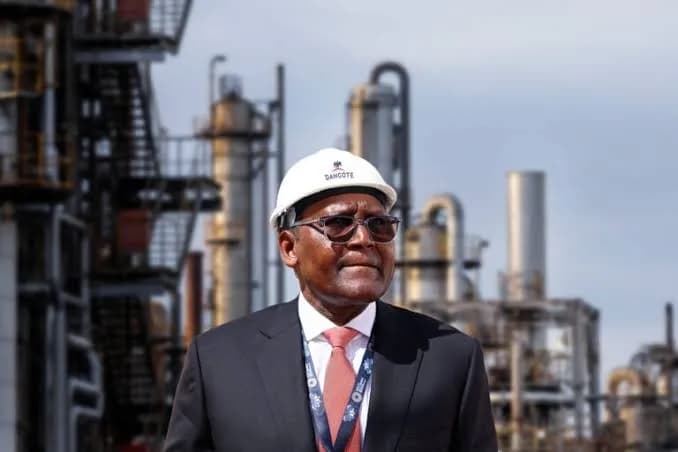
Dangote Petroleum Refinery and Petrochemicals has withdrawn its lawsuit against the Nigerian Midstream and Downstream Petroleum Regulatory Authority (NMDPRA), the Nigerian National Petroleum Company Limited (NNPCL), and several fuel marketers over the issuance of petroleum import licences.
The company submitted a notice of discontinuance to the Federal High Court in Abuja through its legal counsel, Ogwu Onoja (SAN). Although the application did not state any reason, it confirmed that Dangote had opted to halt legal proceedings.
Last year, the refinery initiated the case with originating summons FHC/ABJ/CS/1324/2024. It accused NMDPRA of breaching Sections 317(8) and (9) of the Petroleum Industry Act (PIA) by granting import permits without first proving a national shortfall in fuel supply. Dangote argued that such actions discouraged local refining and undermined the development of domestic production.
The company demanded ₦100 billion in damages and named seven defendants: NMDPRA, NNPCL, AYM Shafa Ltd, A. A. Rano Ltd, T. Time Petroleum Ltd, 2015 Petroleum Ltd, and Matrix Petroleum Services Ltd.
Marketers, Regulators Reject Monopoly Allegations
In response, three fuel marketing firms, AYM Shafa, A. A. Rano, and Matrix Petroleum, filed a joint counter-affidavit through senior advocate Ahmed Raji. They urged the court to dismiss the suit, warning that Dangote’s objective was to dominate fuel supply, pricing, and distribution.
The marketers argued that a single refinery should not dictate national fuel availability. They cautioned that relying solely on Dangote could cripple Nigeria’s fuel security if the refinery ever shut down. Furthermore, they pointed out that NMDPRA issued licences under Section 317(9) of the PIA, which permits importation when local supply cannot meet demand.
NMDPRA aligned with that view. A regulatory officer, Idris Musa, affirmed that the refinery’s output could not yet serve the entire market. The authority said it granted import permits to companies with solid track records in international fuel trading to maintain supply stability. Musa also stressed that NMDPRA’s role includes promoting competition and preventing monopolies.
The authority denied Dangote’s allegations of bias and clarified that its mandate requires protecting market fairness, not favouring any single operator. It also noted that Dangote’s products are not restricted to Nigeria and can be traded globally.
NNPCL, on its part, raised a procedural objection. Represented by Mr. Kehinde Ogunwumiju (SAN), the company said Dangote had sued an incorrectly named entity and lacked the legal standing to seek the reliefs requested. However, Justice Inyang Ekwo dismissed the objection and allowed Dangote to amend the summons to correct the error.
Legal Battle Ends, Industry Focus Returns to Market Balance
Justice Mohammed Umar had scheduled a full hearing for September 29. But with the lawsuit now withdrawn, attention returns to broader concerns over pricing, deregulation, and competition in the downstream oil market.
Although Dangote’s 650,000-barrel-per-day refinery remains a major asset in Nigeria’s energy ambitions, this legal retreat suggests a more pragmatic shift in its approach to competing forces in the industry.