

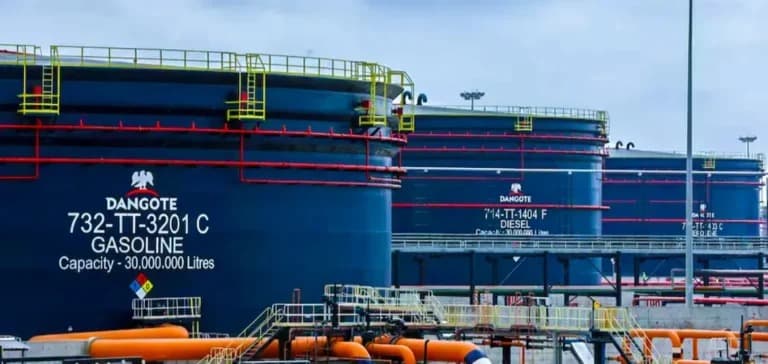
The decision by Dangote Petroleum Refinery to begin pricing refined petroleum products in United States dollars has exposed a deeper structural challenge within Nigeria’s oil industry, highlighting the country’s inability to consistently supply enough locally produced crude to its largest refinery despite being Africa’s biggest crude oil producer.
The 700,000 barrels-per-day refinery announced that petrol, diesel and aviation fuel will now be benchmarked in dollars after persistent shortages under the Federal Government’s naira-for-crude initiative forced it to source a significant portion of its feedstock from the international market, where crude transactions are denominated in dollars.
Under the new pricing structure, petrol is benchmarked at $0.779 per litre (about ₦1,075 per litre), diesel at $1.087 per litre (about ₦1,500 per litre), while Jet A1 aviation fuel is priced at $0.942 per litre (about ₦1,300 per litre). Although domestic marketers will continue to make payments in naira, the equivalent amount will be determined using the prevailing exchange rate, exposing wholesale fuel prices more directly to fluctuations in the foreign exchange market.
The development marks a significant shift from the objective of the naira-for-crude policy introduced in 2024, which was designed to enable domestic refiners purchase Nigerian crude in naira, reduce demand for foreign exchange and shield the downstream petroleum sector from exchange rate volatility.
According to the refinery, it requires between 13 and 15 crude cargoes every month to sustain operations. However, the Nigerian National Petroleum Company Limited (NNPCL) supplied only seven cargoes in May, an improvement from about five cargoes previously but still far below operational requirements. The shortfall has compelled the refinery to purchase additional crude supplies on the international market.
The situation presents a striking contradiction for Nigeria. While the country exports more than one million barrels of crude oil daily, its flagship refinery continues to depend partly on imported crude to maintain production, underscoring longstanding challenges surrounding domestic crude allocation and supply.
Industry observers say the refinery had spent months absorbing the additional costs associated with purchasing crude in dollars while selling refined products in naira. The latest pricing adjustment suggests that the arrangement had become commercially unsustainable.
Since commencing large-scale operations, Dangote Refinery has significantly transformed Nigeria's downstream petroleum market by sharply reducing the country's dependence on imported petrol and strengthening local refining capacity. However, the latest development indicates that securing adequate domestic crude has emerged as the refinery's biggest operational challenge.
The refinery's decision also raises fresh questions about the effectiveness of Nigeria's domestic crude supply framework and whether existing policies are sufficient to guarantee feedstock availability for local refiners. Without a reliable mechanism to prioritise domestic crude allocation, analysts warn that the country may struggle to maximise the economic benefits expected from its expanding refining capacity.
As Nigeria continues efforts to strengthen energy security and reduce reliance on imported petroleum products, industry stakeholders say resolving the domestic crude supply challenge will be critical to ensuring the long-term sustainability of the country's refining sector.