

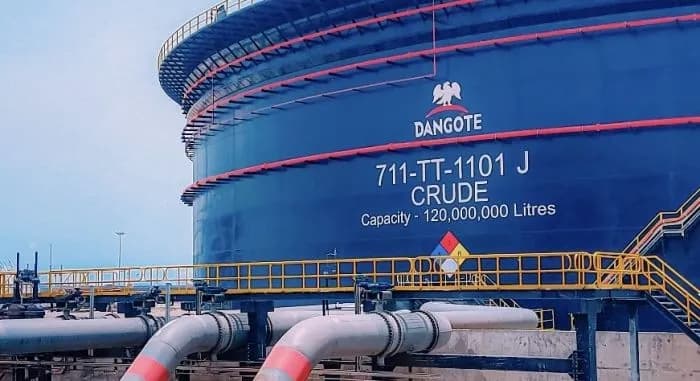
In just over six months, Dangote Petroleum Refinery reviewed its ex-depot petrol (PMS) price Thirteen times through sharp cuts, tactical hikes, a brief pause in naira sales, and targeted rebates firmly establishing itself as the benchmark setter for Nigeria’s downstream market. Rather than import landing cost dictating pump realities, traders, depot owners, and marketers increasingly key off Dangote’s board.
Thirteen price moves that reset the market (Jan–Aug 2025)
- Jan. 19 — ₦950/L
First major hike: from ₦899.50 to ₦950 per litre on crude strength (~$82 Brent) and higher logistics. Still undercut rivals (e.g., AIPEC ₦970, AITEO ₦972), signalling cost leadership. - Feb. 1 — ₦890/L A swift ₦60 cut as crude softened, showcasing an agile pricing model.
- Feb. 26 — ₦825/L (Ramadan discount) With Brent below $65, Dangote trimmed another ₦65, widening the edge over import-dependent terminals.
- Mar. 14 — ₦815/L A marginal ₦10 relief that kept pricing below import parity.
- Mar. 19 — Naira sales suspended Faced with FX distortions, the refinery paused naira-based sales and withheld PFIs, exposing the mismatch between dollar crude and naira off-take.
- Apr. 10 — ₦865/L (sales resume) After a federal nod to continue the naira-for-crude model, Dangote re-entered below key rivals (AIPEC ₦888.67, Rainoil ₦900).
- Apr. 16 — ₦835/L (price war trigger) Within 24 hours, BOVAS and SAHARA cut by ₦15, kicking off an intense Lagos depot price war.
- May 12–20 — ₦10/L rebate (effective ₦825/L) A post-loading rebate quietly rolled out, paused, then reinstated let marketers pay ₦835 upfront and recover ₦10 after loading, prolonging Dangote’s retail advantage and forcing rivals like Pinnacle and MRS Tincan to shade prices.
- Jun. 20 — ₦880/L A surprise ₦55 hike on Middle East tensions, higher U.S. crude imports, and FX pressure Lagos depots moved up in tandem.
- Jun. 30 — ₦840/L Ten days later, Dangote cut back, reclaiming price leadership as crude benchmarks eased; depots reset to ₦860–₦865.
- Jul. 8 — ₦820/L Lowest since March 14; aimed at reinforcing price leadership ahead of August 15 rollout.
- Aug. 12 — ₦820/L The latest drop triggered an immediate market freeze as marketers halted liftings, waiting for rivals to match the new benchmark.
A live demonstration: market froze on August 12
Midday, Aug. 12, 2025, private depots were transacting around ₦850/L. Examples included:
- MENJ — ₦850
- MAO — ₦850
- A.A. Rano — ₦850
Once Dangote reversed to ₦820/L, buying stopped almost immediately. Marketers halted liftings, waiting for a market-wide reset. Before close, Pinnacle revised to ₦822/L, validating a pattern traders now recognise: Dangote moves first, the market follows. Participants expected further alignment today toward Dangote’s print.
Why landing cost no longer sets Nigeria’s benchmark
Traditional import parity rests on a stack of dollar-denominated inputs: FOB, freight, lightering, NPA/NIMASA/jetty throughput, storage, financing, and demurrage converted at current FX.
Yet July’s MEMAN recent report show landing costs far above transferable reality:
- Jul. 28 FOB $675.00, Freight $67.77, Other Costs $71.14, FX ₦1,534.21/$ →Landing Cost: ( PMS ₦862.93/L )
Note: “Other Costs” bundle lightering, NPA, financing, storage, jetty throughput, and port/demurrage. The PDFs aggregate these in USD rather than itemising in naira.
Despite these import economics, Dangote cleared ex-depot volumes in the ₦820–₦850/L band less than half of import parity. In effect, domestic refining plus naira-for-crude has broken the old tether to landing cost and replaced it with a refinery-led benchmark.
What Dangote’s benchmark means for the value chain
- Depot operators: Must mirror Dangote quickly or watch liftings stall. Even a ₦5–₦10 spread can freeze demand until a reset lands.
- Marketers: Margins compress and stocks reprice in hours. Tactical buying around Dangote’s cadence becomes critical to avoid inventory losses.
- Consumers: Benefit episodically as competitive rounds push pump prices lower, though FX and crude volatility can reverse gains.
- Importers: Import parity is effectively non-binding in a market anchored by local molecules and rebates.
The strategic levers behind dominance
- Cost position: Local barrels strip out hefty freight/port externalities embedded in imports.
- Speed: Frequent, data-led repricing (including discretionary rebates) shapes expectations and behaviour.
- Signalling power: A single board decision now re-prices Lagos, then radiates nationwide.
Outlook: H2 2025 will remain volatile on Dangote’s clock
With Brent hovering near $60 and reforms still unfolding, expect continued high-frequency repricing. Unless FX or feedstock terms shift materially, Dangote not landing cost remains Nigeria’s downstream benchmark.