

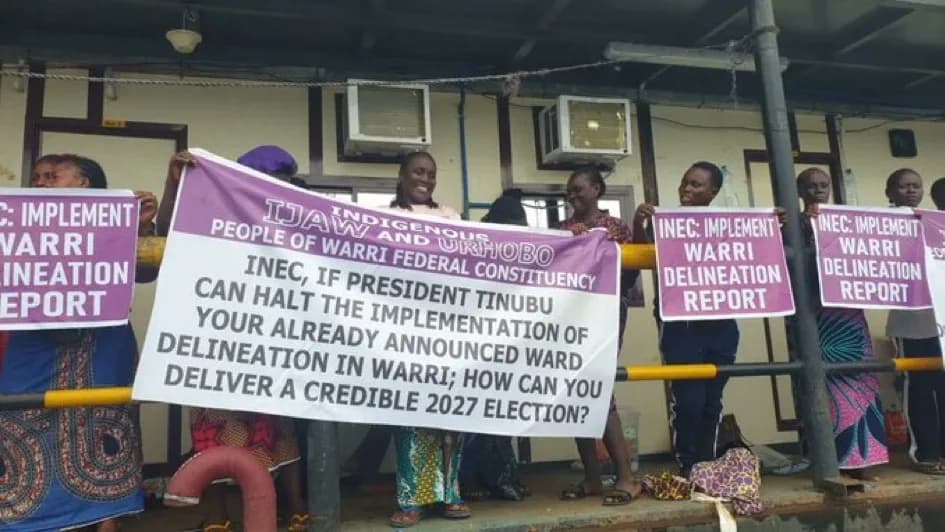
Operations at 13 oil flow stations in Delta State have been disrupted following protests by community members demanding the implementation of a ward delineation report, a development that could place up to 400,000 barrels per day of crude oil production at risk.
The protest, which spread across parts of the Warri Federal Constituency on Monday, affected facilities operated by Renaissance Africa Energy Company, Chevron Nigeria Limited and Nestoil/Neconde, according to industry sources familiar with operations in the area.
Sources said the affected installations collectively account for approximately 400,000 barrels of daily crude oil production, raising concerns about the potential impact on Nigeria's output levels, export commitments and oil revenues if the disruption persists.
The affected flow stations include Odidi 1, Odidi 2, Batan, Ogbanabou, Jones Creek, Otunana, Egwa 1, Egwa 2, Abiteye, Makaraba, Olero Creek, Dibi Field and Opuekeba.
Community members, largely women and youths from Gbaramatu, Ogbe-Ijoh, Isaba, Egbema and Diebiri kingdoms across Warri South, Warri South-West and Warri North local government areas, reportedly occupied the facilities and restricted access to operational personnel.
Industry sources also indicated that movement of logistics supplies through waterways serving the affected facilities was disrupted, further affecting field operations.
The protest is linked to the implementation of an electoral ward delineation exercise conducted by the Independent National Electoral Commission (INEC) in compliance with a Supreme Court judgment delivered in 2022.
Protesters are demanding the enforcement of the final delineation report presented to stakeholders in Asaba on May 20, 2026, insisting that crude oil operations will remain affected until the report is implemented.
The action follows renewed controversy surrounding the delineation exercise, which has generated tensions among Ijaw, Urhobo and Itsekiri communities within the constituency.
Photographs circulating online showed demonstrators carrying placards bearing messages such as: "INEC: Implement Warri Delineation Report," "Court Ordered Judgement on Wards and Polling Units Delineation," and "No Implementation, No Production."
Other banners called on INEC to implement the approved state constituencies and registration areas presented during the stakeholder engagement in Asaba, while some questioned the credibility of future electoral processes if the delineation outcome remains unimplemented.
Speaking on behalf of the protesters, community representative Maria Ebike said residents had exhausted other avenues in seeking implementation of the report.
She maintained that the protest would continue until authorities take steps to enforce the delineation outcome, arguing that the process had already been completed and only required implementation.
Other community leaders echoed similar concerns, describing the delineation exercise as an effort to address longstanding issues relating to political representation within the constituency.
The dispute traces its roots to a Supreme Court ruling directing INEC to undertake a fresh delineation of wards and polling units in the Warri Federal Constituency. Following consultations and field assessments, the electoral commission conducted the exercise and subsequently presented its report to stakeholders in Delta State.
However, disagreements over the outcome have continued among the various ethnic groups in the area, reflecting the political sensitivity of the constituency.
The disruption comes as Nigeria seeks to increase crude oil production and strengthen revenue generation from the petroleum sector. A prolonged shutdown of facilities with a combined capacity of about 400,000 barrels per day could affect production targets and export volumes.
Nigeria's crude oil production stood at approximately 1.66 million barrels per day in April, representing about 99 per cent of its production quota under the Organisation of the Petroleum Exporting Countries (OPEC).
As of the time of filing this report, neither the affected operators nor relevant regulatory authorities had publicly disclosed the scale of production losses resulting from the disruption.
The protesters, however, insist that the occupation of the facilities will continue until progress is made on the implementation of the ward delineation report ahead of preparations for the 2027 general elections.