

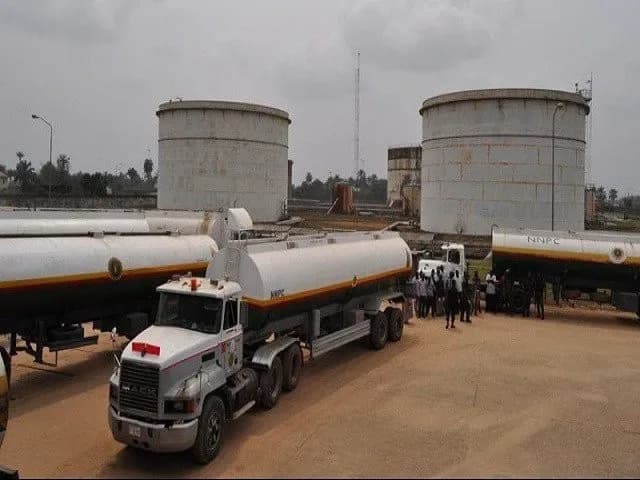
Depot fuel prices declined across major supply hubs on Wednesday as marketers reduced the prices of Premium Motor Spirit (PMS) and Automotive Gas Oil (AGO), while global crude oil prices continued their downward trajectory.
A market survey by Petroleumprice.ng as of 4:40 p.m. WAT showed fresh price reductions at depots in Lagos and Warri, with PMS selling for as low as ₦1,120 per litre and diesel dropping to ₦1,455 per litre at some Lagos depots.
The latest adjustments came as international oil prices weakened further, with Brent crude falling 2.45 per cent to $71.16 per barrel and U.S. West Texas Intermediate (WTI) declining 2.03 per cent to $68.09 per barrel, extending losses recorded in recent trading sessions.
In the Lagos depot market, Integrated lowered its PMS price to ₦1,120 per litre, while Pinnacle and Techno Oil sold at ₦1,121 per litre.
Other marketers, including Ascon, Sahara, African Terminal, and Bono, also quoted PMS at ₦1,120 per litre, indicating increasing competition among wholesale suppliers.
In Warri, A.Y.M Shafa offered PMS at ₦1,123 per litre.
Diesel prices also recorded fresh downward reviews during the trading session.
Duport reduced its AGO price from ₦1,460 to ₦1,455 per litre, while Ibeto cut its price from ₦1,480 to ₦1,465 per litre.
Other Lagos depots, including Ibachem, T.Time, and Menj, sold diesel at ₦1,465 per litre, while Aiteo and African Terminal priced the product at ₦1,460 per litre.
Outside Lagos, Stockgap in Port Harcourt maintained an AGO price of ₦1,480 per litre, while A.Y.M Shafa quoted ₦1,480 per litre in Warri and Edo Refinery sold at ₦1,490 per litre.
The latest price reviews followed continued weakness in the international oil market, where investors remained focused on supply expectations despite renewed uncertainty surrounding diplomatic efforts between the United States and Iran.
Market sentiment remained largely bearish after Iranian officials indicated that Tehran would not hold direct talks with U.S. representatives in Qatar until issues surrounding last month's interim peace agreement are resolved.
Despite the diplomatic uncertainty, expectations of improved crude supply have continued to weigh on prices. Analysts noted that although tanker traffic through the Strait of Hormuz remains below normal levels, inbound vessel movements have gradually increased, signalling improving confidence among shipowners following last month's ceasefire agreement.
The latest decline in depot prices also comes amid increasing pressure from the Federal Government for petroleum marketers to ensure that movements in international crude oil prices are reflected more promptly in domestic fuel prices. Speaking earlier this week, the Minister of State for Petroleum Resources (Oil), Senator Heineken Lokpobiri, urged operators to pass on the benefits of lower crude prices to consumers, stressing that while the downstream sector remains deregulated, regulators would not tolerate excessive profiteering at the expense of Nigerians.
Similarly, the Federal Competition and Consumer Protection Commission (FCCPC) recently questioned why pump prices had not fallen proportionately despite the sharp decline in global crude prices, warning that it would continue to monitor the market for exploitative or anti-competitive practices.
However, petroleum marketers have pushed back against suggestions of any form of price control. The Independent Petroleum Marketers Association of Nigeria (IPMAN) warned that any attempt by the Federal Government to compel retailers to sell below commercially sustainable levels could disrupt product supply, insisting that prices in a deregulated market should continue to be determined by market forces and prevailing acquisition costs.
The continued decline in international crude prices has increasingly filtered into Nigeria's wholesale petroleum market, prompting depot operators to adjust prices as replacement costs ease.
Market participants will now be watching whether the latest reductions at the depot level translate into further cuts in retail pump prices in the coming days if global oil prices remain under pressure.