

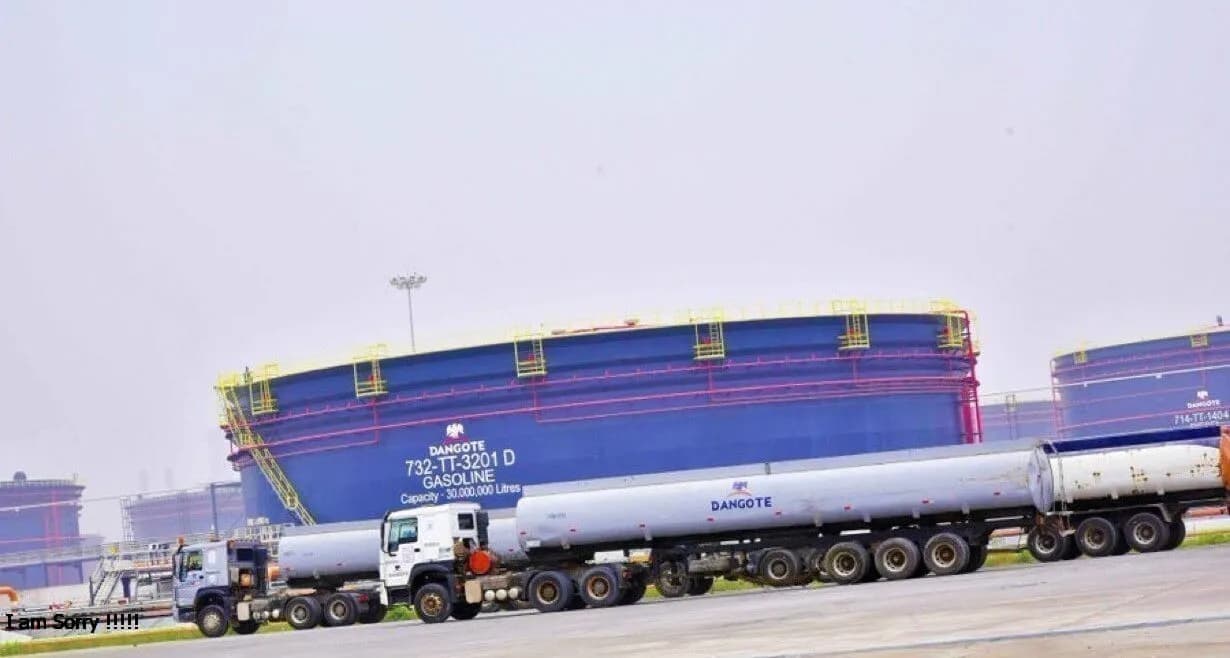
Nigeria’s downstream oil sector is bracing for a new wave of competition as the Dangote Petroleum Refinery sets a fresh gantry price of ₦820 per litre, effective Monday, September 15, 2025. The refinery’s direct supply of Premium Motor Spirit (PMS) with free delivery is already reshaping depot dynamics, with marketers cutting prices in anticipation of the new benchmark.
Dangote’s Pricing Template Resets the Market
Under the new structure, retail pump prices are expected to stabilise around ₦841 in Lagos, Ogun, Oyo, Ondo, Osun, and Ekiti, while Abuja, Rivers, Delta, Edo, and Kwara will see prices at ₦851. By offering free nationwide delivery, Dangote has effectively slashed logistics costs that typically inflate petrol prices by ₦10 to ₦20 per litre.
This bold strategy immediately sent ripples across the market, forcing independent depots to recalibrate their rates ahead of Monday’s rollout.
Depots React with Price Reductions
Price adjustments were swift in Lagos and Calabar, signalling how depots are positioning themselves in response to Dangote’s distribution plan:
- Lagos:
- WOSBAB cut prices from ₦848 to ₦836
- AITEO eased from ₦845 to ₦836
- MENJ cut prices from ₦846 to ₦838
- Calabar:
- SOROMAN slashed prices from ₦853 to ₦843
- Port Harcourt:
- MASTERS cut prices from ₦869 to ₦864
This trend in Lagos, Port-Harcourt and Calabar demonstrates the pressure to align with Dangote’s competitive edge.
Competitive Pressure Redefines Supply Chain
The refinery’s move does more than introduce a new price point it changes the rules of engagement. By absorbing delivery costs, Dangote is directly challenging depot operators whose margins depend heavily on transportation mark-ups. This approach not only strengthens its appeal to marketers but also forces rivals to rethink supply efficiency.
In Lagos, the immediate ₦12 drop by WOSBAB reflects how quickly market players are responding. Calabar’s reduction further highlights how regional depots are preparing to compete with a model that eliminates one of their long-standing advantages: logistics-based pricing.
Dangote–NUPENG Frictions in the Background
However, this market shake-up is not without controversy. The Nigeria Union of Petroleum and Natural Gas Workers (NUPENG) has raised concerns over Dangote’s operational model, particularly around labour issues and the exclusion of unionised workers in parts of the supply chain. While these disputes have not slowed the refinery’s rollout, they add another layer of complexity to Nigeria’s evolving downstream landscape.
Industry players are watching closely, as prolonged friction with NUPENG could spark disruptions in distribution networks or fuel industrial actions that offset the expected market gains.
Outlook for Marketers and Consumers
For petrol station owners, Dangote’s entry into direct distribution offers an opportunity to secure cheaper and more reliable supplies, potentially improving retail competitiveness. For consumers, the early reductions point to possible relief at the pump as depots pass on lower costs.
However, industry watchers warn that smaller depots may struggle to sustain margins if Dangote expands aggressively into their territories. The refinery’s expansion plan, starting with selected states and moving nationwide, could accelerate consolidation in the downstream sector.
In short, Dangote’s distribution launch is more than a price adjustment it is a restructuring of Nigeria’s PMS supply chain, complicated by ongoing labour tensions that could shape the next phase of the industry.