

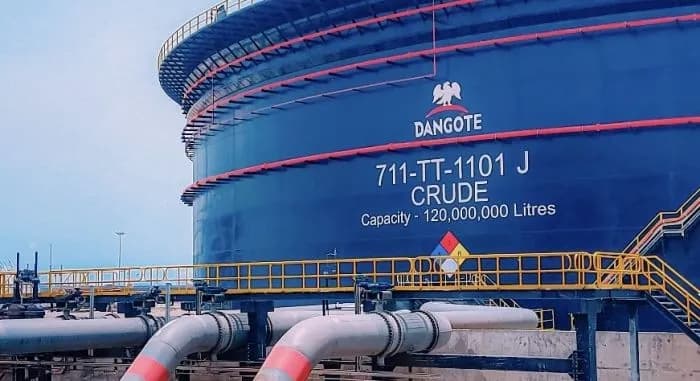
Depot prices for Premium Motor Spirit (PMS) in Nigeria spiked by up to 7% on Thursday, as Dangote Petroleum Refinery abruptly suspended petrol sales across its terminals, deepening supply uncertainty and accelerating price movements nationwide.
The suspension communicated internally by the refinery’s commercial operations department comes as global crude benchmarks continue their modest ascent, amplifying tensions in a market already strained by forex pressures and volatile distribution costs.
At 11:10 a.m., Brent crude traded at $72.66, and WTI crude at $69.42, both inching slightly higher than Wednesday’s levels of $72.16 and $68.85, respectively. Since Monday, international crude has gained over 5.5%, fueling broader pricing adjustments in Nigeria’s deregulated fuel market.
Dangote Issues Sales Suspension Notice
In a notice titled “Important Update on DPRP Collection Account for PMS”, Dangote Petroleum Refinery instructed marketers to halt all payments for PMS loading at its gantry, effectively freezing further allocations.
“Please be advised that, effective immediately, all payments to the DPRP collection account for PMS gantry should be placed on hold,” the internal memo read. “Further updates will be communicated shortly.”
No official reason was stated for the suspension, though sources familiar with the matter suggest internal reconciliation and reallocation may be underway following rising global crude import costs and tightening margins.
Depot Prices Surge Across Key Terminals
In response, PMS depot prices surged across multiple coastal and inland hubs, with some terminals posting retail-ready prices near the ₦900/litre mark, a fresh high for the month.
Port Harcourt Depots:
- Masters Energy: ₦845 → ₦897
- Ever Oil: ₦845 → ₦900
Warri Depots:
- A.Y.M Shafa: ₦845 → ₦890
- Matrix: ₦845 → ₦890
Calabar Depots:
- Zone 4: ₦833 → ₦900
- Hyde Energy: ₦845 → ₦890
Lagos Depots:
- Nipco: ₦825 → ₦870
- Aiteo: ₦820 → ₦870
The widespread upward revisions in PMS pricing reflect both actual cost hikes and speculative positioning by marketers uncertain about Dangote’s next move. Industry analysts say the refinery’s temporary withdrawal may tighten product availability, at least in the near term, if not addressed swiftly.
Diesel Prices Also Trend Higher
Automotive Gas Oil (AGO) prices continued to climb, with some depots posting dual-tier pricing structures that reflect broader sourcing volatility.
Lagos Depots (AGO):
- Nipco: ₦1010 → ₦1130
- Chipet: ₦1003 → ₦1130
While diesel prices remain unregulated, the near-parallel increase with PMS signals supply chain overlap and shared exposure to upstream cost variables, particularly in FX-dependent import channels.
Market Bracing for Retail Spillover
Although depot-level PMS prices have yet to fully translate into pump prices nationwide, stakeholders warn that continued upward pressure combined with a suspension of Dangote’s distribution could trigger a wave of retail adjustments in the coming days.
“Depot prices are reacting immediately to the absence of Dangote volumes,” one marketer told this publication. “Unless sales resume quickly or other suppliers step in, the gap could widen even further.”
Uncertainty Deepens Ahead of New Cycle
With crude oil still on a gradual rise and no clarity yet from Dangote on when PMS sales will resume, market tensions remain elevated. Many operators are re-evaluating their short-term allocation strategies while consumers brace for potential changes at the pump.
Industry watchers say the next 48 hours will be critical for supply-chain confidence, especially as Nigeria approaches its month-end fuel loading cycle.