

The United Kingdom’s refining industry is facing one of its weakest years since 2017, as refinery closures and reduced capacity push output towards a post-pandemic low. According to the Joint Organisations Data Initiative (JODI), UK refinery production totalled 4.104 million tonnes in January–July 2025, down from 4.207 million tonnes during the same period in 2024.
The sharp decline stems from key shutdowns, including Petroineos’ 150,000 b/d Grangemouth refinery in Scotland and Prax’s 105,700 b/d Lindsey plant in eastern England. These closures have reshaped Europe’s refining landscape, with ripple effects on trade flows and gasoline supply chains.
Gasoline Output Drops, Imports Rise
Average monthly gasoline output in the UK fell by 58,000 tonnes to 1.201 million tonnes between January and July, while gasoil production dropped by 92,000 tonnes to 1.357 million tonnes. Although marginal increases in jet-kerosene and fuel oil partly cushioned the fall, the broader trend is clear: the UK is becoming more import-dependent.
In fact, average net gasoline imports rose by 24,000 tonnes per month, reaching 805,000 tonnes. At the same time, exports dropped to 344,000 tonnes per month the lowest in over five years. UK gasoline stocks fell to a 38-month low of 795,000 tonnes in July, underscoring supply tightness.
Dangote Refinery Rewrites Africa’s Trade Balance
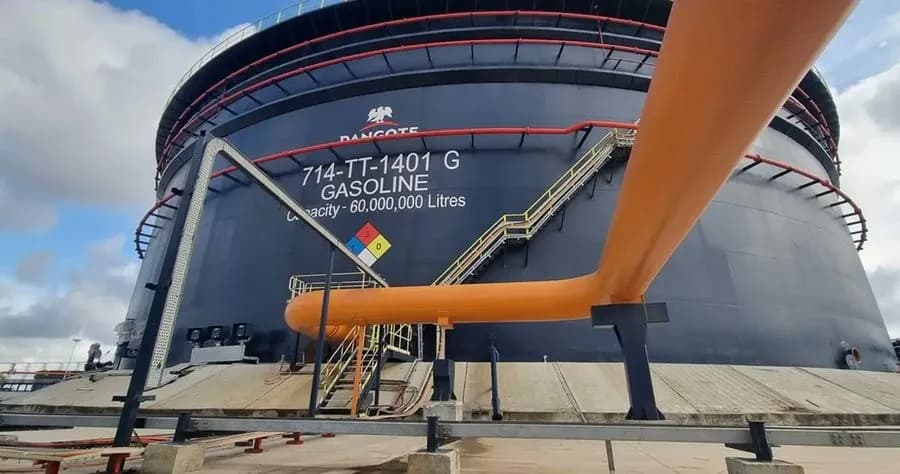
While Europe struggles with shrinking refining capacity, Africa is witnessing a transformation led by Nigeria’s 650,000 b/d Dangote Refinery. The mega-refinery has become a cornerstone of regional supply, ensuring steady product flows even as European arbitrage opportunities weaken.
For African markets, this represents a strategic shift. Instead of relying heavily on European exports, countries can increasingly source products locally, cutting costs, reducing shipping times, and strengthening regional energy security. Dangote’s output is gradually turning Africa from a dependent consumer into a competitive refining hub.
Implications for Global Trade Flows
The closures in Europe combined with steady African refining growth are reshaping product economics. European surplus volumes, once destined for Africa, are dwindling, narrowing arbitrage margins. This dynamic not only strengthens African bargaining power but also highlights the growing imbalance between mature and emerging refining regions.
Meanwhile, UK demand for gasoline has failed to offset falling exports. Domestic consumption in January–July averaged 1.092 million tonnes per month, down 20,000 tonnes year-on-year despite growth in hybrid and gasoline vehicle uptake. Gasoil demand also declined, by 77,000 tonnes per month, to 1.529 million tonnes.
A New Energy Map Emerges
The decline of UK refining and the rise of African capacity mark a turning point in global energy flows. For decades, Europe supplied surplus fuel to Africa. Now, with Dangote at full throttle and Europe trimming capacity, the tables are turning.
The narrative is no longer about Africa’s dependence, but about African dominance in refining capacity. As more regional projects come online, from modular refineries in West Africa to expansion plans in Angola, Africa is positioned to become not just self-sufficient, but an exporter in its own right.
The Bottom Line
European refinery are closing down signalling a decline of an old order, while Nigeria’s Dangote Refinery embodies the dawn of a new one. The shift is more than symbolic it reflects how investment, infrastructure, and strategic vision can rewrite energy maps.
For Africa, this is a moment of transformation: from an importer to a regional refining powerhouse, reshaping global trade flows and proving that energy independence is not just possible, but already underway.