

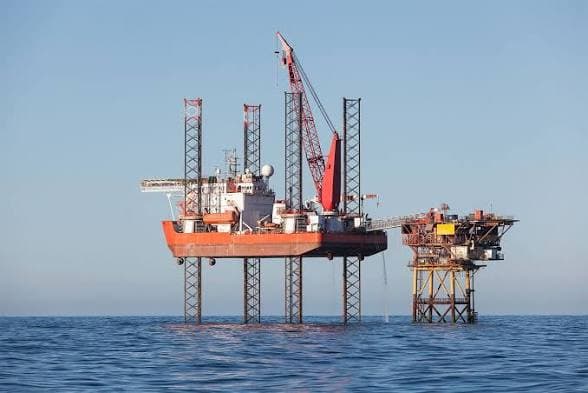
The Federal Government has introduced a new fiscal incentive that could give fresh deepwater oil projects a significantly more attractive starting position, resetting the profit-oil sharing ratio to 70:30 in favour of contractors even when older production in the same contract area has already moved to a higher government share.
The provision is contained in the Deep Offshore Oil and Gas Projects Incentives (Tax Remission) Order, 2026, signed by President Bola Tinubu on August 6 and subsequently gazetted by the government.
Under the new Profit Oil Reset mechanism, an approved greenfield development will not inherit the more burdensome profit-oil sharing level reached by existing production within the same contract area. Instead, the sliding scale will restart for the new project at 70 per cent for the contractor and 30 per cent for the government.
The Gazette stated, “Where a Profit Oil Reset is approved, the applicable profit oil sliding scale shall restart only for the approved eligible project development, such that the allocation of profit oil ratios between Contractor and the Concessionaire shall commence at a ratio of 70:30 as between the contractor and government in respect of the eligible project development, notwithstanding that existing production elsewhere in the same contract area has already graduated the profit oil ratios to a higher step in the profit oil sliding scale.”
The incentive, however, is targeted at genuinely new developments. To qualify, a project must be a greenfield crude oil or non-associated gas development for which a Final Investment Decision had not been taken when the order commenced. The FID must be taken by December 31, 2029, although the deadline may be extended where force majeure prevents compliance.
The order also provides production tax credits of up to $3 per barrel for qualifying projects with producible reserves of up to 400 million barrels and up to $4.50 per barrel for projects with higher reserves. Future leases may receive an additional $1 per barrel, while qualifying deep offshore gas projects can receive up to $1 per thousand standard cubic feet, depending on their hydrocarbon liquids content. A supplementary production tax credit may also be granted, with combined standard and supplementary credits capped at $11.50 per barrel for oil projects and $8 per barrel of oil equivalent for non-associated gas projects.
The policy is designed to address one of the biggest barriers facing deepwater developments: the scale of capital required before a project begins generating returns. Professor Emeritus of Petroleum Economics, Wumi Iledare, welcomed the investment objective but warned that the fiscal concessions must translate into additional value for Nigeria. “The more important petroleum economics question is: How much incremental value will the tax remission create for Nigeria relative to the economic rent and government revenue forgone? That is the test that should guide our assessment of DOEO 2026,” he said.
Iledare noted that deepwater projects carry substantial capital, geological, cost and market risks, adding that the reported potential to unlock as much as $50bn in investment, including the approximately $10bn Bonga Southwest project, was significant. He cautioned, however, that investment announcements alone should not be the measure of the policy’s success.
The order further requires qualifying project activities to be undertaken in Nigeria, except for critical-path activities or cases where domestic execution would cost more than 10 per cent above the alternative, subject to an approved Nigerian Content Plan. The Nigeria Revenue Service is expected to issue implementation guidelines within 45 days covering applications, economic valuation, computation, monitoring and project ring-fencing.
The government has also built a clawback mechanism into the framework, allowing improperly obtained tax credits to be withdrawn and recovered where beneficiaries provide false statements, misrepresent information, submit incorrect data or breach the conditions attached to their approvals.