

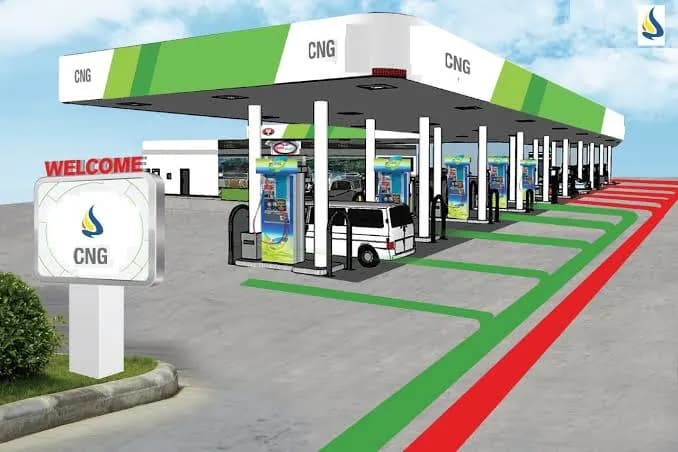
The Federal Government of Nigeria has set a target of 2,322 Compressed Natural Gas (CNG) stations nationwide by 2027, intensifying efforts to expand gas mobility infrastructure, lower transport costs and accelerate Nigeria’s shift towards alternative fuels.
The Executive Chairman and Chief Executive Officer of the Presidential Initiative on Compressed Natural Gas and Electric Vehicles (PICNG), Ismaeel Ahmed, disclosed this at the Nigerian Oil and Gas Midstream and Downstream Summit in Lagos. Represented by agency official Olayinka Rufai, Ahmed said Nigeria has moved from having commercial CNG availability in barely one state to active operations in 24 states within less than three years.
“Today, in less than three years, we now have 24 states active. We are looking at what goes on elsewhere. I think we can safely say that it is probably the fastest we have seen anywhere in the world, especially if you consider the conditions under which we are doing this, the economy, and everything,” he said.
Ahmed disclosed that over 100,000 vehicles have already been converted to run on CNG, with commercial operators accounting for a large share of the uptake due to the programme’s focus on reducing the cost burden on commuters and transport users.
“Because of the palliative nature with which we started, the majority of those vehicles turned out to be commercial vehicles, because we intended to make an impact that touched the common man,” he said, adding that the initiative has attracted more than $1 billion in direct investments into Nigeria’s emerging gas mobility market.
On infrastructure growth, Ahmed said the country currently has 72 operational CNG refuelling stations, with 175 more under development, while 28 compression stations are active and another 65 facilities are being built to support gas distribution.
“And believe you me, that number continues to climb. Whatever number you see today, we expect to triple it in less than 18 months, which will, of course, increase the capacity to supply, which we hope should drive greater interest and greater demand,” he said.
He noted that much of the expansion has been driven by local entrepreneurs, with over 350 conversion centres already established nationwide and limited involvement from major operators.
“We have done this primarily without much involvement of the major. So you can only imagine when they finally kick in, how that growth of retail supply infrastructure will explode,” Ahmed stated.
The PICNG boss also revealed that more than 5,600 Nigerian technicians have been trained and certified in CNG conversion technologies to ensure adequate technical support as adoption grows.
“You can have 100 well-placed conversion centres, and you convert everything and give yourself 10. But what happens when the car is on the road and you have millions of mechanics who today don’t know anything about the CNG-converted vehicle?” he asked.
Ahmed further disclosed that 4,318 CNG tricycles have been deployed across Nigeria, with 95 per cent assembled locally, while making a strong economic case for gas adoption.
“The compelling argument is simple. CNG is ₦380 to ₦450 per standard cubic metre, which is the equivalent of one litre of petrol, which is ₦1,300 to ₦1,350 per litre. You do the maths. Where would you rather be?” he said.
He added that the government is also widening its clean mobility agenda beyond gas by preparing pilot electric vehicle projects and charging infrastructure. According to him, the initiative’s 2027 roadmap targets one million vehicle conversions, 3,000 active conversion workshops, 75,000 direct jobs and 300,000 indirect jobs across the country.