

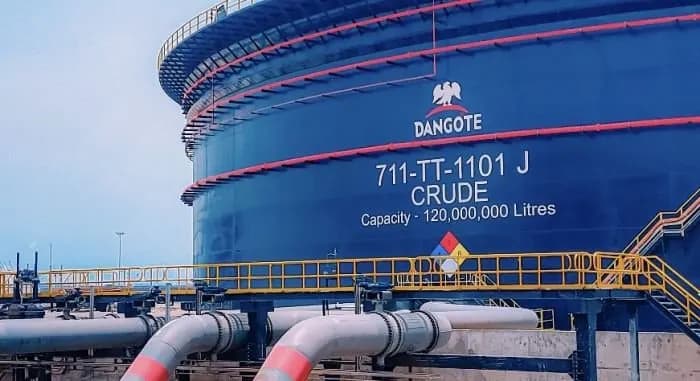
Nigeria’s downstream sector is facing renewed pressure after Dangote Petroleum Refinery increased the ex-depot price of Automotive Gas Oil (diesel) to ₦1,300 per litre, marking a cumulative ₦420 rise within one week.
Market sources told Petroleumprice.ng that the refinery suspended loading activities earlier on Thursday to review its pricing template before announcing the latest upward adjustment.
The development comes just two days after the refinery raised its diesel gantry price on March 3 by ₦170, moving from ₦880 to ₦1,050 per litre.
Marketers Face New Loading Cost
According to industry sources, marketers who were unable to lift product before the latest adjustment are now required to increase their down payment by ₦250 per litre, effectively bringing the loading price to ₦1,300 per litre.
The rapid price changes have unsettled bulk buyers and depot marketers, many of whom had positioned for loading under the earlier price structure.
Refinery Cites Global Market Disruptions
In a statement, Dangote Petroleum Refinery said the recent pricing adjustments are linked to volatility in the global oil market, triggered largely by the ongoing conflict in the Middle East.
The refinery explained that the crisis has forced shutdowns and reduced production at some refineries worldwide, tightening the global supply of petroleum products.
It also noted that China has suspended exports of gasoline and diesel, further constraining international supply.
According to the refinery, these disruptions have pushed Brent crude prices up by about 26 per cent to above $84 per barrel within a short period.
The company said it continues to procure crude oil at prevailing international prices, adding that Nigerian crude typically trades at a premium of $3 to $6 above Brent, while freight costs of about $3.50 per barrel raise the landing price of crude processed at the refinery to between $88 and $91 per barrel.
Dangote Refinery added that although it receives about five crude cargoes monthly from the Nigerian National Petroleum Company Limited (NNPCL), paid for in naira, the volume remains significantly below the 13 cargoes required monthly to sustain full domestic supply.
As a result, the refinery said it often has to source additional crude from international traders using foreign exchange at open market rates, which increases production costs.
The company also stated that insufficient supply from domestic upstream producers, as envisaged under the Petroleum Industry Act (PIA), has compelled it to rely more on international crude purchases at additional premiums.
Despite these pressures, the refinery said it remains committed to maintaining supply to the Nigerian market and helping cushion the country from global energy supply shocks.
It added that the company is accelerating the deployment of Compressed Natural Gas (CNG)-powered trucks to improve distribution efficiency and reduce logistics costs in the downstream sector.
However, the sharp increase in diesel prices is expected to transmit quickly through the broader economy. As AGO remains the primary fuel for transportation, manufacturing, and power generation across many industries, the higher cost could drive up logistics, production, and service expenses. Analysts warn that these pressures may ultimately translate into higher prices for goods and services, adding fresh inflationary strain on businesses and households.