

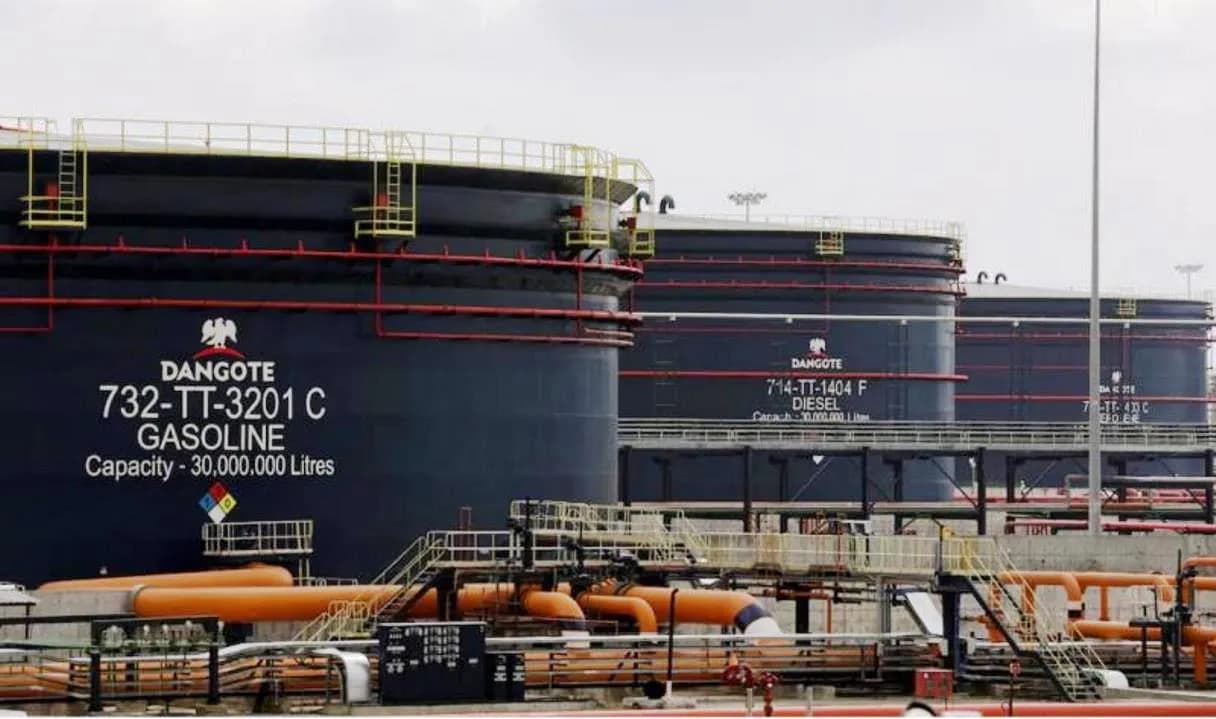
As global crude oil prices trend downward, a fresh wave of price competition is intensifying in Nigeria’s downstream petroleum market. Several private depot operators in Lagos have quietly slashed their ex-depot rates for key products Premium Motor Spirit (PMS), Automotive Gas Oil (AGO), and Liquefied Petroleum Gas (LPG) signalling what insiders say may force Dangote Petroleum Refinery to follow suit imminently.
Private Depots Undercut Dangote’s Fuel Prices
In the latest pricing data tracked between 23rd and 27th June 2025, top private depots including Aiteo, Nipco, and Aipec are now offering PMS at ₦870, ₦870, and ₦874 per litre respectively undercutting Dangote Refinery’s ex-depot rate of ₦880 by at least ₦6 to ₦10. Insiders claim the situation is becoming unsustainable for Dangote, which is now seen to be maintaining a price premium despite having the advantage of being a refinery.
Similarly, AGO prices are stable at ₦1000/litres across major depots such as African Terminal, Ibachem, Menj, Mao, Ibeto, and Integrated Oil. In contrast, Dangote’s AGO price is noticeably higher at ₦1023/litres. Rainoil remains the only depot close to Dangote’s pricing, offering diesel at ₦1003/litre.
Meanwhile, in the LPG segment, Ardova is offering LPG at ₦890/kg the same rate as other competitors meaning Dangote has little to no price advantage in this category either.
Insiders Hint at Looming Dangote Price Cut
Industry insiders have now revealed that Dangote may be preparing to lower its PMS and AGO prices in the coming days to remain competitive. “There are strong indications that Dangote will crash its prices today,” a source with knowledge of the refinery’s pricing strategy confirmed to Petroleumprice.ng. “With most private depots now selling cheaper, it’s only a matter of time before Dangote realigns to sustain market share.”
Market Dynamics: Competitive Pressure Mounts
The pricing gap has caused many marketers especially independent marketers to shift their supply preference away from Dangote, seeking better margins from private depots offering more competitive rates. A Lagos-based depot manager stated, “Private depot owners are aggressively pricing to gain market share. Marketers will always follow the cheaper source, and this is already influencing lifting volumes.”
Adding to the pressure is the recent decline in global crude oil prices. As of today, Brent crude is trading around $67.63 per barrel, marking a modest but notable decrease from previous weeks. This international trend could provide further justification for domestic price reductions, especially from a major player like Dangote who sources crude locally for refining.
The Broader Picture: Pricing Power Decentralised
This emerging price war points to a decentralisation of pricing power in Nigeria’s downstream sector. Initially, Dangote Refinery attempted to set premium benchmarks for refined products. However, the agility of private depots, combined with their willingness to adapt quickly, is tilting market influence in their favour.
While Dangote still benefits from scale and infrastructure, its higher pricing may soon be untenable if the current trend continues. Should the refinery choose to maintain its price stance, it risks further volume losses, especially as the market becomes increasingly price-sensitive amid ongoing economic pressures.
All Eyes on Dangote’s Next Move
As PMS, AGO, and LPG prices fall at private depots, analysts believe the downstream market is entering a phase of realignment. The question now is not if Dangote will reduce its prices but when. Whether prompted by market realities or internal strategic adjustments, Dangote’s response could set the tone for pump prices in July and beyond.
One thing is certain: the Nigerian fuel market is no longer a monopoly of giants. It is evolving into a dynamic, competitive landscape driven by price, efficiency, and consumer preference.