

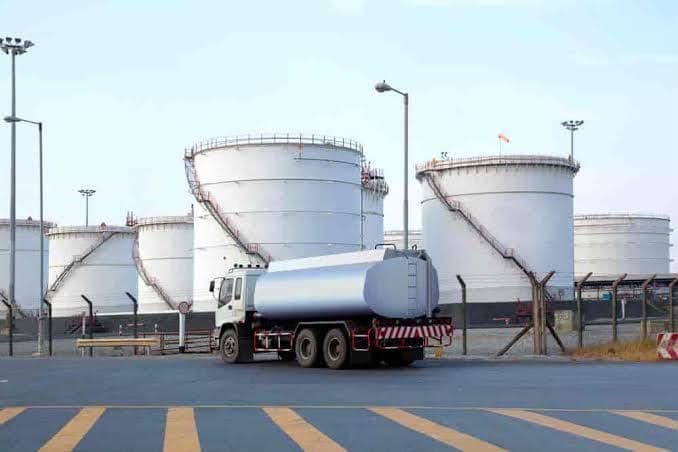
Nigeria's downstream petroleum market has recorded its sharpest weekly price surge in months, with petrol loading prices at private depots climbing by ₦200 per litre, representing a 18.6 per cent, barely one week after Dangote Petroleum Refinery replaced its naira pricing regime with a dollar-denominated sales model.
Checks by Petroleumprice.ng indicate that petrol, which sold for an average of ₦1,075 per litre across major Lagos depots on July 13, is now loading at approximately ₦1,275 per litre, as marketers struggle with rising replacement costs fuelled by higher crude oil prices, exchange rate exposure and tightening domestic supply.
Before the current market disruption, depot prices had remained largely stable despite moderate fluctuations in international crude oil prices. Dangote Refinery's naira-based sales model, backed by the Federal Government's crude-for-naira initiative, had provided marketers with a level of pricing certainty that helped moderate volatility across the downstream market.
That stability ended on July 13, when Dangote Petroleum Refinery formally announced the transition to United States dollar sales for petroleum products. Under the new pricing template, Premium Motor Spirit (PMS) was fixed at $0.779 per litre, Automotive Gas Oil (AGO) at $1.087 per litre, and Aviation Turbine Kerosene (ATK) at $0.942 per litre, while LPG transactions were exempted from the new arrangement.
In a notice obtained by Petroleumprice.ng, the refinery informed customers that all previously issued naira-denominated Proforma Invoices and Deal Recaps had become invalid. The company stated: "Following our email on the 9th of July, 2026, regarding the transition from Naira to United States Dollars, please note that all issued Naira Coastal and Gantry PFIs/Deal Recaps are now invalid, and no payments should be made against them." It further stated that "the applicable USD prices for each product, effective today, July 13, 2026, are provided below," explaining that the transition reflected the refinery's crude procurement obligations, which are increasingly settled in foreign currency.
The announcement immediately changed the pricing outlook across the downstream sector. Rather than purchasing products based on a fixed naira price, marketers were suddenly required to calculate replacement costs using both the prevailing exchange rate and international crude oil prices. Within days, private depots began adjusting prices upwards as operators sought to protect themselves against mounting foreign exchange risks.
The pressure intensified after product loading activities at Dangote Refinery slowed significantly. Today marks the sixth consecutive day since loading was suspended, leaving marketers to compete for limited volumes available at private depots. The tighter supply environment accelerated price increases across Lagos, with depot owners reviewing gantry prices almost daily in response to strong demand.
The domestic supply challenge has coincided with a sharp deterioration in the international oil market. Renewed hostilities between the United States and Iran, coupled with growing concerns over shipping through the Strait of Hormuz, have driven global crude oil prices sharply higher. As at the time of writing, Brent crude was trading above $91 per barrel, its highest level in months, significantly increasing the replacement cost of imported petroleum products and crude feedstock.
The convergence of these factors has fundamentally altered pricing across Nigeria's downstream market. Within just seven days, average petrol gantry prices in Lagos have risen from ₦1,075 per litre to ₦1,275 per litre, representing an increase of ₦200 per litre, or 18.6 per cent. Industry operators say the market is now responding not only to domestic supply conditions but also to global oil price movements and foreign exchange volatility.
The immediate concern for marketers is whether the current trend will translate into another round of pump price adjustments. With depot acquisition costs continuing to rise and international crude prices remaining elevated, operators warn that sustained pressure on the supply chain could force retailers to review pump prices upward unless loading resumes at Dangote Refinery and crude supply issues are resolved.
For now, the downstream market remains in a period of heightened uncertainty. Industry stakeholders are closely monitoring three critical developments: the resumption of petrol loading at Dangote Refinery, the outcome of discussions on crude supply under the naira-for-crude arrangement, and the direction of global crude oil prices as geopolitical tensions continue to reshape the international energy market.