

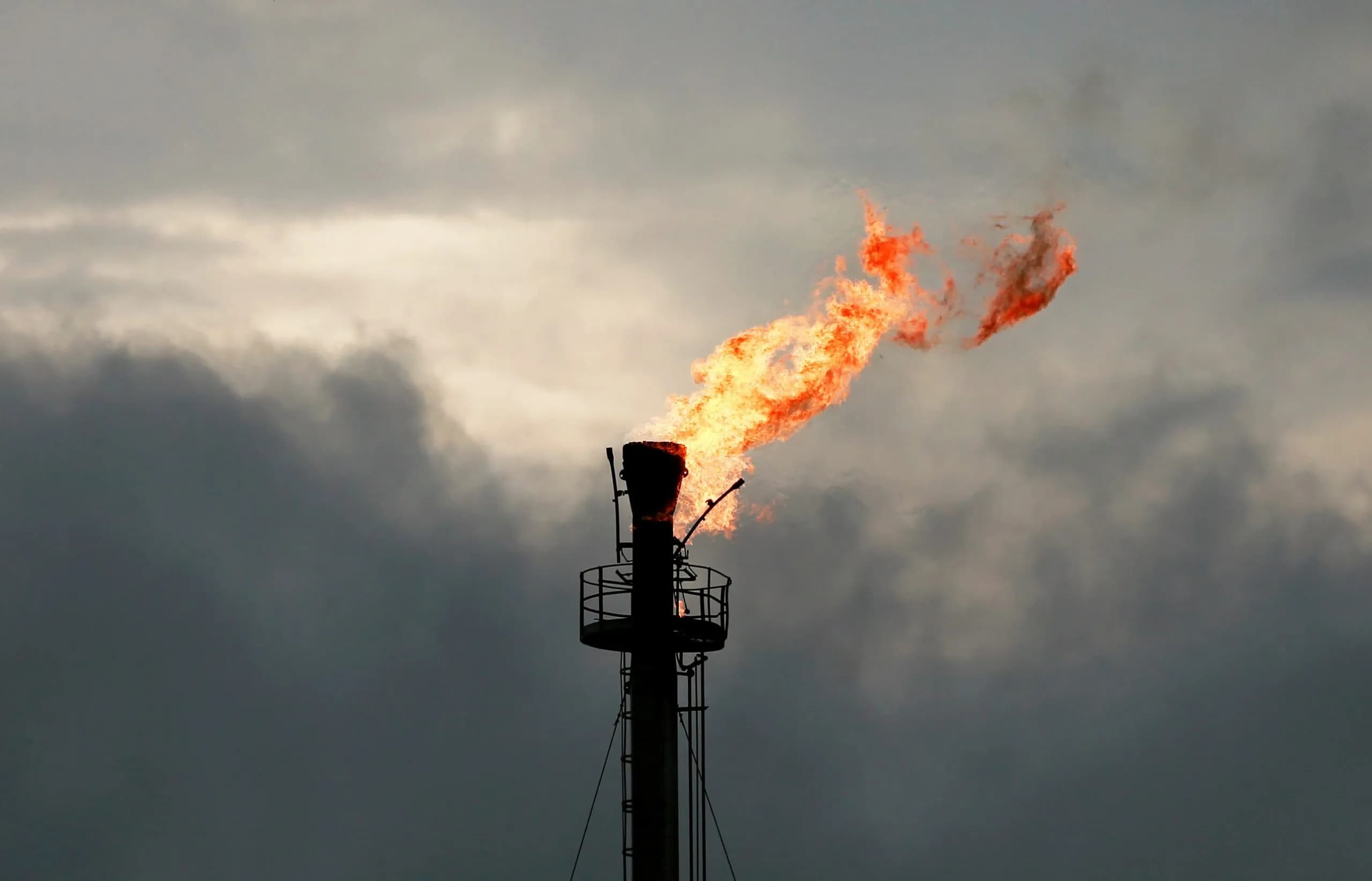
Nigeria is wasting more gas than it has in years while factories are shutting down or running at half capacity due to energy shortages. New data shows that gas flaring rose to a four-year high between January and May 2025, highlighting a troubling contradiction in Africa’s biggest oil-producing nation: billions of cubic feet of gas burnt off uselessly, while homes and industries go without power.
$1.1 Billion Burnt, Zero Benefit
According to figures from the Nigerian Oil Spill Monitor, backed by the National Oil Spill Detection and Response Agency (NOSDRA), oil and gas companies flared an estimated 301.1 million standard cubic feet of gas (mscf) in just five months from January to May 2025.
That’s equivalent to roughly $1.1 billion worth of gas enough to power millions of households and thousands of factories across Nigeria for months.
To put this in perspective, the gas flared could generate over 30,000 megawatt-hours (MWh) of electricity a huge chunk of Nigeria’s unmet demand.
“This level of flaring is unacceptable, especially when we are crying for gas in manufacturing and power sectors,” said an energy economist at the Lagos Business School.
Who’s Flaring and Why?
Industry insiders say the bulk of this waste is happening in onshore and shallow water fields precisely the assets now largely operated by indigenous oil companies, following the exit of several multinational firms.
These smaller operators often lack the infrastructure to capture and process associated gas, leaving them with no option but to flare it.
Meanwhile, existing penalties for gas flaring set at $2 per 1,000 standard cubic feet are widely considered too low to drive behavioural change, especially with oil prices above $70 per barrel.
Factories Struggle While Gas Burns Away
While oil firms burn gas at the flare stacks, Nigeria’s manufacturing sector is starved for energy. Many factories rely on diesel generators an expensive and dirty substitute. Others, especially in steel, glass, and cement industries, require gas as a critical input and are either importing LPG at high cost or operating below capacity.
A recent survey by the Manufacturers Association of Nigeria (MAN) showed that over 60% of firms report power-related production losses, many of which could have been avoided if domestic gas supply was reliable.
The Climate Contradiction
This wasteful flaring not only hurts the economy it hurts the climate. Nigeria is one of the top seven gas-flaring countries globally, despite signing onto global climate agreements and committing to net-zero emissions by 2060.
According to the World Bank’s Global Gas Flaring Tracker, gas flaring contributes heavily to Nigeria’s greenhouse gas emissions, particularly methane, a far more potent warming agent than CO₂.
“We are flaring gas we could sell or use, while also undermining our climate promises. It’s economic sabotage wrapped in environmental disaster,” a renewable energy consultant noted.
What Does the Law Say?
The Petroleum Industry Act (PIA) of 2021 introduced tougher rules on gas flaring and offered incentives to commercialise flared gas. It also created the Midstream and Downstream Gas Infrastructure Fund to support investments in pipelines and processing plants.
Yet, enforcement has been weak. Only a few gas capture projects have taken off, and industry observers argue that the gap between policy and practice remains wide.
Where Do We Go From Here?
Experts are calling for urgent action to turn wasted gas into productive energy. Suggestions include:
- Raising flaring penalties to reflect true economic and environmental costs
- Fast-tracking gas infrastructure projects, especially in gas-prone regions like the Niger Delta
- Mandating gas monetisation as a condition for field development
- Providing fiscal support for indigenous firms to invest in gas handling technology
At a time when Nigeria is pushing for industrialisation and foreign investment, the inability to capture and utilise gas sends the wrong signal.
The Irony We Can’t Afford
Nigeria is burning what it desperately needs and that irony comes at a high cost.
While $1.1 billion in natural gas goes up in smoke, factories are closing, power supply remains erratic, and environmental targets drift further out of reach.
Without strong leadership and urgent enforcement, gas flaring could continue to haunt Nigeria’s energy and economic ambitions, turning potential into pollution.